
Sermon 12.21.2025: Rejoice! Rejoice!
In a dream, Joseph received a startling message from God turned his world upside down, and Joseph's faithfulness in responding to God's dream, changed the world. We rejoice for all who hear God's dreams and respond with faith instead of fear.
Advent 2025: Soon and Very Soon
This Advent, we acknowledge our need for radical hope. The scriptures from this season encourage us to prepare for God's best, yet it sometimes feels like we are living in the “worst of times.” Can we hold fast to the promise that “soon and very soon” we are going to see the hope, peace, joy, and love of God manifest in our lives and int the world? Soon and very soon, friends, soon and very soon. This Advent, we wait with hope.
Scripture
Matthew 1:18-25
Now the birth of Jesus the Messiah took place in this way. When his mother Mary had been engaged to Joseph, but before they lived together, she was found to be with child from the Holy Spirit. Her husband Joseph, being a righteous man and unwilling to expose her to public disgrace, planned to dismiss her quietly. But just when he had resolved to do this, an angel of the Lord appeared to him in a dream and said, ‘Joseph, son of David, do not be afraid to take Mary as your wife, for the child conceived in her is from the Holy Spirit. She will bear a son, and you are to name him Jesus, for he will save his people from their sins.’ All this took place to fulfil what had been spoken by the Lord through the prophet:
‘Look, the virgin shall conceive and bear a son,
and they shall name him Emmanuel’,
which means, ‘God is with us.’
When Joseph awoke from sleep, he did as the angel of the Lord commanded him; he took her as his wife, but had no marital relations with her until she had borne a son; and he named him Jesus.
Sermon
Have you ever looked at the families in Christmas advertisements and commercials?
They are all beautiful. They wear outfits that are coordinating, but not
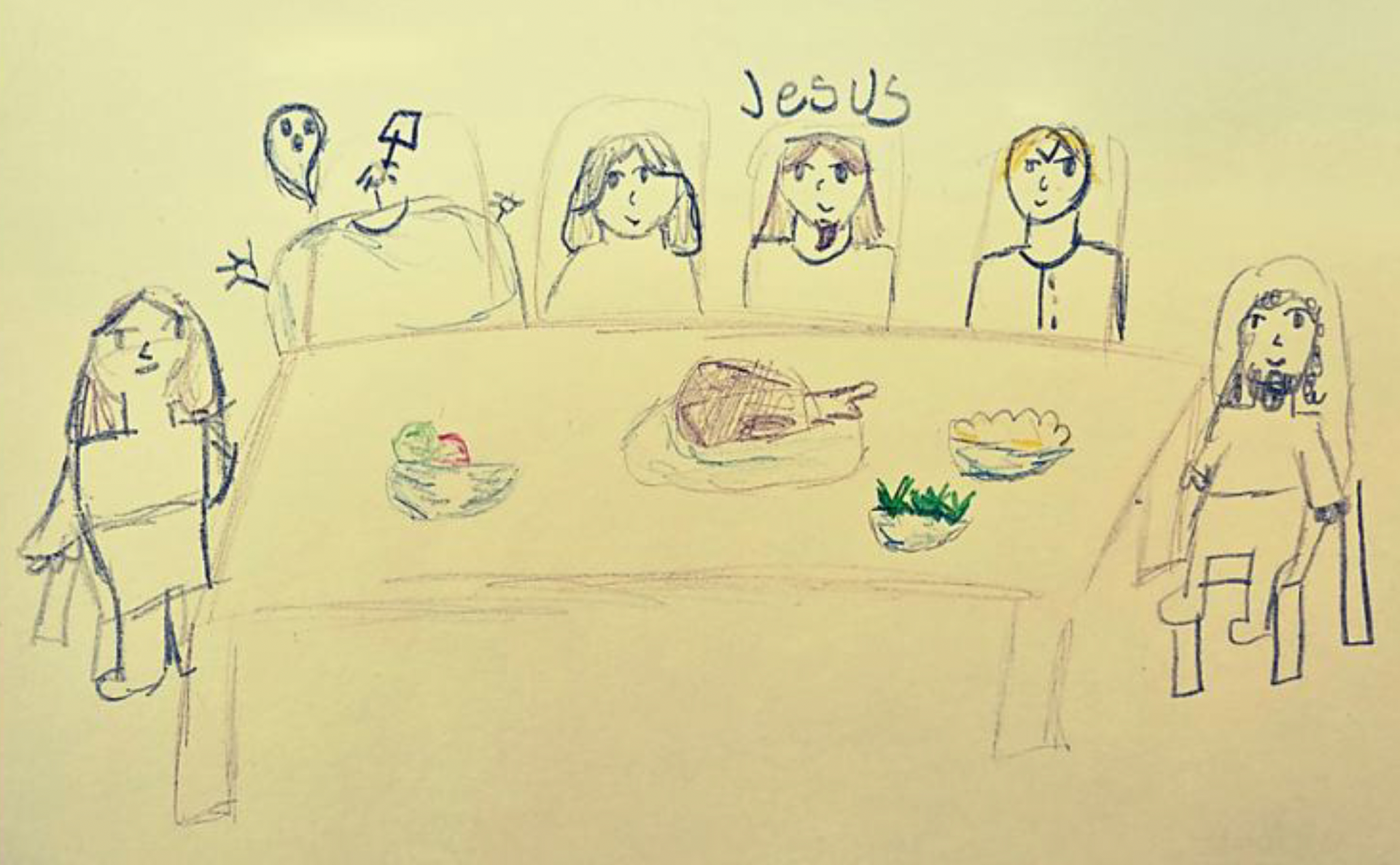
too matchy-matchy. They are uniformly happy and joyful. They are gathered together around a perfectly decorated tree in a gorgeous home. They have 10 people around a perfectly set table, in front a perfectly prepared feast.
I don’t know about you, but that’s not what our holidays have ever looked like in my whole life. On Christmas, we sit around the tree in our pajamas with our hair a mess. And when the boys were younger, it was always a good time until someone got shot in the face with the new nerf gun.
Those ads with the perfect families don’t show the anxiety of the parents who just spent too much money on Christmas in an effort to keep up with the Joneses.
They don’t show the people who are alone on Christmas because they don’t have family nearby.
They don’t show that cousin, Jimmy, didn’t show up for the meal because he is in a fight with his dad.
Those ads don’t show how the mom has a migraine because she just cooked for 24 hours straight to prepare the perfect meal, wrap all the presents, and make everything just so.
They don’t show that the conversation is about the weather, because if they started talking about religion or politics, some people would get up and leave.
They don’t show the sadness at the table because it is the first holiday since a loved one died.
My point is that e’ve bought into a false image of what the holidays should be. We look at these ads and wonder,
“Why isn’t my life like that?”
When, in reality, we should be looking at these ads and wondering,
“Who
are these people?”
Because, as wonderful as our families may be, they aren’t perfect.
I know you already know that.
But I encourage you this week, as you prepare to head toward Christmas, to give yourself permission to take a deep breath and truly believe that. No human family is perfect.
And when you start to doubt it and start getting sucked back in to the illusion of those elusive perfect families, read this text from Matthew’s gospel.
Because if God wanted to enforce and perpetuate our efforts to worship perfect families, we wouldn’t be reading this story from Matthew.
In the perfect version, Mary and Joseph would have been high school sweethearts and would have safely have already walked down the aisle before news of the pregnancy leaked. Not to mention that they would have lived in Rome or Athens, and not in a backwoods town under occupation. And they wouldn’t have had to have angels intervene for their relationship to successfully proceed.
The story we have from Matthew’s story today shows us that God walked right into imperfect lives,
just like ours,
and became flesh and lived among us. Emmanuel, God is with us.
Right before this text, Matthew gives us his account of Jesus’ genealogy and I encourage you to look through it in all your free time before Christmas. Mixed in with all of the begats are some interesting names.
There are women mentioned, which is worth noting.
There’s Tamar, who seduced her father in law because he wouldn’t give her in marriage to one of his other sons after her husband had died.
There’s Ruth, who was a foreigner, an undocumented refugee, and the grandmother of King David.
There’s Bathsheba, who King David wanted, but she was already married. So David had her husband killed in battle so he could take her for himself, and you probably can guess what happened to her.
Matthew doesn’t hide these stories about Jesus ’ancestors. By mentioning the women by name, he actually highlights them. He wants you to notice these mentions and remember their stories. From the beginning of his gospel, Matthew makes it clear
that Jesus is the Messiah, AND that his “pedigree” is only perfect in its imperfection.
Matthew’s genealogy ends like this:
“and Jacob the father of Joseph the husband of Mary, of whom Jesus was born, who is called the Messiah.”
What do you notice there?
Jesus’ lineage goes back to Abraham through Josephe’s side of the family. Not Mary’s. The only way for that to happen, according to what the Bible tells us, is through adoption. Jesus the Messiah, the son of God, is adopted by a carpenter from Nazareth named Joseph.
It almost didn’t turn out that way.
When Joseph found out that Mary was pregnant, he made plans to quietly dismiss her. What he should have done, according to religious and social customs, was to publicly shame her and have her stoned. Dismissing her quietly was the more compassionate response of those two options.
We‘re told only that Mary was “found to be with child from the Holy Spirit.” The scene with Mary and the Angel and Mary’s song, the one we heard last week, isn’t told in Matthew’s gospel, only Luke’s. I’m a little annoyed with Matthew for leaving out a pretty important part of the story.
But maybe this version more closely resembles women’s experience.
Women’s lives every day are dependent on people believing what the woman says about her own sex life. From discussions of contraception to legalization of abortion, from unplanned pregnancies to stories of rape and assault. Think back to the news stories and consider the burden of proof we put on women when they tell stories about what happened to their own bodies. The Epstein files come to mind.
Before you declare that first century Palestine was too dangerous for women, but things are fine here, ask yourself how Mary would fare today if she were “found to be with child from the Holy Spirit.” Think about how we care for single moms today.
Would politicians today support her?
Religious leaders?
What did Joseph make of the story Mary told him about her pregnancy?
If he was planning on dismissing her quietly, it doesn’t sound like he was fully on board with her story.
And then the angel came to him.
“Joseph, son of David, do not be afraid to take Mary as your wife, for the child conceived in her is from the Holy Spirit. She will bear a son, and you are to name him Jesus, for he will save his people from their sins.”
Using the greeting of angels throughout scripture, do not be afraid, the angel tells Joseph to take Mary as wife and to claim the son she will bear by naming him.
And Joseph agrees to go along with this plan. We don’t often hear about Joseph’s call. But he was called. By an angel. Joseph accepted the call to adopt the son of God and support his wife’s calling. By saying yes to the angel, to God, Joseph tied his complicated and messy story into the very narrative of God’s salvation for the world.
I confess I wish Joseph didn’t need the angel’s visit before he could believe Mary’s story. I suppose that is a part of my Advent journey, longing for the world I know can exist, but which we don’t see fully realized quite yet. It breaks my heart that Mary’s testimony wasn’t enough for him.
We don’t seem to have as many angel visits these days, at least not as they are described in scripture. Maybe today, Joseph’s angel would be the waitress at the diner, willing to listen to his predicament, willing to call him out for not believing his fiancée.
Maybe today, his angel would be his friends at church, who ask him to consider what he stands to lose if he dismisses Mary.
Maybe his angel visit would be a friend who was willing to sit with him while he cried over the death of his perfect image of what his story was going to be.
You and I know what the angel said to Joseph. And we know Mary will get her own visit from an angel because we’ve read Luke’s gospel. But Mary and Joseph’s families didn’t get a visit from the angel. They hadn’t read this script.
What do you think Joseph’s mother thought about the plan? He’s a son of David. He can trace his lineage back to Abraham and the Mayflower, for goodness sake. How do you think she reacted to the news?
Yet Joseph stood up to social convention and, presumably, his mother, and answered God’s call.
For Joseph, the faithful response was at odds with social conventions.
Has that ever happened in your life?
Have you ever felt that the best way for you to be true to yourself and true to who God was calling you to be required you to be at odds with the culture around you?
I suspect many of you could tell your own story of the time you had to stick up for your child, or when someone stood up for you, when you knew doing the right thing was not the easy thing.
I think about those of you who have stood up for your children as they have come out with a sexual orientation or gender identity at odds with what society considers ‘normal’. You know what it is to be faithful, when even the church wasn’t always on your side.
This perfectly imperfect story of Joseph cuts very close to my own life. Many of you know some of my story about adoption.
For me, having a baby when I was in college and then placing him for adoption was not how I dreamed about the perfect life I thought I was supposed to live. It certainly wasn’t how I pictured living out my life in faith either.
Yet, when I ended up in that situation, the best way I could figure out to be true to who I was and true to who I thought God was calling me to be, was to place my son for adoption.
The public nature of my situation brought about some comments. There were people who didn’t think that a pregnant teen could call herself a Christian and felt a need to share God’s “love” with me that way.
Thankfully, however, most of the people I encountered through that year must have been visited by angels as they slept.
Because I met a lot of people like Joseph. People who were righteous and could have easily shunned me.
But didn’t.
They welcomed me at church and at school. They took care of me. They took me out to lunch. They protected me.
I can’t tell you how thankful I am for all of those Josephs, and for whatever angels it took for them to be able to greet my situation with grace. Their love for me through the difficult hours of my life showed me God’s love in ways that words never could have.
And my very imperfect story became the perfect one for me. My son is still in my life, all these years later and remains one of the biggest gifts.
When are the times in your lives when you’ve encountered a Joseph? When your life was so far from perfect that you didn’t know what was going to happen next?
We heard Mary’s Magnificat, her song of praise, last week. I understand it in new ways in light of this story, thinking about what a relief Joseph’s decision must have been for her. She knew her own truth but was still at the mercy of how a man was going to interpret it.
And how open are we to being like the post-angel-visit Joseph? When we are we willing to set aside what society, or even church, tells us is the “right” thing to do so that we can do the faithful act?
And can we let go of the idea that someone else’s story is picture perfect while ours is a mess? We need to share the beauty in the brokenness of our own stories so people can journey with us through it. Our perfection is found in our imperfection.
Who in your life needs to encounter a Joseph right now? And are there Josephs who are in need of some angelic help from us?
I’m thankful the angel intervened and spoke with Joseph. Because the other alternatives for Mary were bad. Even if Joseph had just dismissed her quietly, which was the better of the options, she would have lived a quiet and secluded life, cut off from all society, hidden away in her parents ’home. Mary wouldn’t have been able to place the baby for adoption and then finish college and go on to marry the love of her life as I did.
Mary’s life would have been over. And what would have happened to her son, the son of God, born to save his people?
When God came to earth, he picked the perfect family for God’s son. (Almost as good of a family as my son got through adoption, and almost as good as the one I got 57 years ago when I was adopted).
Their perfection wasn’t in their coordinating Christmas outfits or the large number of gifts under the tree. It wasn’t in the amount of money or political clout they possessed. There was nothing, by earthly standards, to recommend them to a divine adoption agency.
Here’s what they did have.
They both said “yes” to the angel.
And they were willing to humble themselves in front of the world in order to do their part to save the world.
And there was compassion and grace ready to supplant judgment, offering a chance at life to the young girl bearing the child
Immanuel,
God is with us,
born to save us all.
Our very salvation was born, in part, because of human compassion in the midst of human imperfection.
As we continue through this Advent journey, let us remember Joseph, willing to answer God’s call.
Here’s part of a poem from David Whyte that sums up our call to be Joseph.
and how we are all
preparing for that
abrupt waking,
and that calling,
and that moment
we have to say yes,
except it will
not come so grandly,
so Biblically,
but more subtly
and intimately in the face
of the one you know
you have to love.
(The True Love, from House of Belonging)
May it be so. Amen.