
Sermon 07.26.2026: Sabbath Means We Are Enough
Why do so many of us feel so much pressure to compete, judge, produce, win? The Parable of the Prodigal Son is about two sons. One son learns the hard way that he doesn’t have to earn his father’s love. The other son doesn’t get it. With which son do you identify?
Scripture
Luke 15:11-32
The Parable of the Lost Son
11 Jesus continued: “There was a man who had two sons. 12 The younger one said to his father, ‘Father, give me my share of the estate.’ So he divided his property between them.
13 “Not long after that, the younger son got together all he had, set off for a distant country and there squandered his wealth in wild living. 14 After he had spent everything, there was a severe famine in that whole country, and he began to be in need. 15 So he went and hired himself out to a citizen of that country, who sent him to his fields to feed pigs. 16 He longed to fill his stomach with the pods that the pigs were eating, but no one gave him anything.
17 “When he came to his senses, he said, ‘How many of my father’s hired servants have food to spare, and here I am starving to death! 18 I will set out and go back to my father and say to him: Father, I have sinned against heaven and against you. 19 I am no longer worthy to be called your son; make me like one of your hired servants.’ 20 So he got up and went to his father.
“But while he was still a long way off, his father saw him and was filled with compassion for him; he ran to his son, threw his arms around him and kissed him.
21 “The son said to him, ‘Father, I have sinned against heaven and against you. I am no longer worthy to be called your son.’
22 “But the father said to his servants, ‘Quick! Bring the best robe and put it on him. Put a ring on his finger and sandals on his feet. 23 Bring the fattened calf and kill it. Let’s have a feast and celebrate. 24 For this son of mine was dead and is alive again; he was lost and is found.’ So they began to celebrate.
25 “Meanwhile, the older son was in the field. When he came near the house, he heard music and dancing. 26 So he called one of the servants and asked him what was going on. 27 ‘Your brother has come,’ he replied, ‘and your father has killed the fattened calf because he has him back safe and sound.’
28 “The older brother became angry and refused to go in. So his father went out and pleaded with him. 29 But he answered his father, ‘Look! All these years I’ve been slaving for you and never disobeyed your orders. Yet you never gave me even a young goat so I could celebrate with my friends. 30 But when this son of yours who has squandered your property with prostitutes comes home, you kill the fattened calf for him!’
31 “‘My son,’ the father said, ‘you are always with me, and everything I have is yours. 32 But we had to celebrate and be glad, because this brother of yours was dead and is alive again; he was lost and is found.’”
Sermon
This parable we call the parable of the prodigal son is one of my favorite passages in the whole Bible. I love it because it is a tightly crafted love story that serves as an antidote to all our images of a God who tallies up our faults and punishes us. And that might seem like enough, but there’s more to this story.
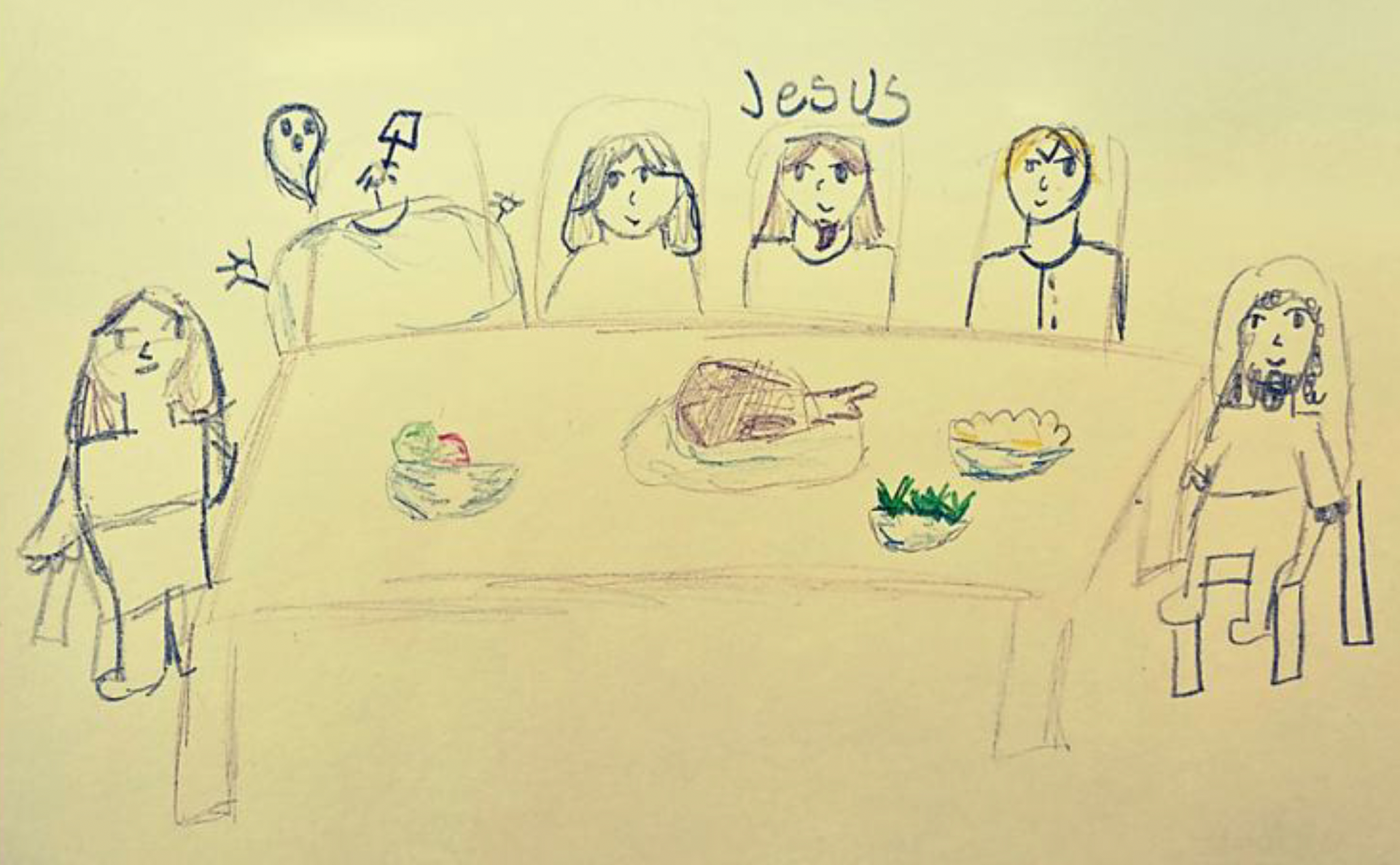
The story begins as Pharisees criticize Jesus for eating with the wrong kind of people: sinners, tax collectors, outcasts. In Jesus’ day, both your diet and your dinner companions were critical, religious matters, but it looks to the Pharisees as though Jesus doesn’t care. In those days, sinners fell into five basic categories. There were the people who did distasteful things for a living, like tax collectors, who worked for the Romans and profited through graft and corruption. Then there were people who did immoral things – fair enough, right? Then there were Samaritans and Gentiles, who had the bad luck of being born into the wrong culture. Finally, there were people who just weren’t as meticulous in keeping the law; most of the ordinary working people who didn’t have the luxury of sitting around debating the finer points of religious law all day long. [ii] The question for us is: Who would it trouble us to see having breakfast with Jesus at Denny’s? An ex-convict? Your ex-spouse? Someone in another political party? Who do you have a hard time forgiving? With whom would you rather not associate? That’s who’s at the table.
Jesus hears the grumbling, but instead of arguing, he tells a brilliant little story about a man and two sons. The younger son essentially tells his father he can’t wait for him to die. He wants his one-third of the estate now. [iii] It’s a huge slap in the face. We get that, but we might miss the huge honor owed the patriarch of a clan and the elaborate code for keeping that honor in place. [iv]
But this father divides the property between the two sons, no questions asked. The younger son takes the money and runs to a distant country where he spends it all on what Jesus delicately calls dissolute living. The older son now has to support the rest of the family on two-thirds of the family resources. Their mother is more vulnerable because losing a son in this culture is like losing a kidney – you need two to survive. [v] This younger son has brought serious dishonor to the family, and then when he’s broke, he takes a job working for Gentiles feeding hogs. For a Jew, this is hitting bottom and then some. [vi] It’s so reprehensible that the Talmud describes a ceremony to deal with it – a qetsatsah ceremony, to punish a Jewish boy who loses the family inheritance to Gentiles. Here’s how it works: If he ever shows up in his village again, the villagers can fill a large earthenware jug with burned nuts and corn, break it in front of the prodigal, and shout his name out loud, pronouncing him cut off from his people. After that, he will be a cosmic orphan, who might as well go back and live with the pigs. [vii]
The younger son “comes to himself.” This isn’t necessarily a great moral breakthrough; maybe he’s just a hungry, exhausted kid who remembers where there are clean sheets and three meals a day. [viii] On the road home he rehearses his speech: “Just treat me like a hired hand but let me come home.” He’s probably hoping to see his father before the villagers with that earthenware jar see him, and that’s what happens. His father sees him coming. We have to wonder: Has the father been out there every day, scanning the horizon, watching, hoping? And he does the most extraordinary, even embarrassing thing. Patriarchs don’t run, but this father hikes up his robe and sprints to his son. Remember, patriarchs don’t run. His son sees him coming and starts his speech, but he can’t get it out because his father’s arms are around him. Finally, the son blurts out, “I’ve sinned; I’m not worthy.” The old man doesn’t even hear it. He’s busy planning the celebration. He turns to his servants and tells them to bring his son the best robe in the house (which would be his own robe). Then, he orders his servants to kill the fatted calf, which signals that the celebration about to take place is not a quiet family affair but a feast for the whole village. It’s a feast to restore the family’s honor as well as a feast to restore the family’s son. [ix] “My son was lost and is found.”
But the parable doesn’t end there. We call this the Parable of the Prodigal Son but there’s that other son, the elder son. Those of us with older siblings recognize this character. He’s hard working. Highly responsible. The “good” son. He’s done everything right; in his mind, he’s earned his father’s love, and he isn’t about to sit down at the same table at a party with that self-centered brat who’s caused his family so much grief. So he refuses to come in the house. This is a terrible insult to his father, right there in front of everyone. The only way for the father to save the evening is to stay right where he is at the head of the table, ignoring his elder son’s conspicuous absence until his guests leave and he can go outside read him the riot act, but we already know this father, right? He’ll do anything to keep his family together. [x]
So for a second time the father leaves the house and goes out to find a lost child: this one lost in his own self-righteousness and pride. “This son of yours,” the older brother says, not “my brother,” but “your son;” “this son of yours” who “wasted your money with prostitutes” – this is who you celebrate? The elder brother is the only one who brings up prostitutes, but the father ignores this as well. “Son, you are always with me; all that I have is yours. But we have to celebrate; your brother was dead and is alive, was lost and has been found.”
Notice that for each son, the love comes before the confession. The younger son doesn’t get to apologize before he receives his father’s forgiveness; the older son doesn’t apologize at all. They have their father’s love not because they earned it, but because loving is what their father does. That is what we call grace.
That’s where the Parable of the Prodigal Son intersects with Sabbath. The Sabbath commandment reminds us that our identity as God’s children does not have to be earned – it is given from God; it is grace. Before we do anything. Before we accomplish anything. So much of our life is earned that we begin to believe we’ve earned everything. The Sabbath teaches us a rhythm between doing and being that helps us accept that much of who we are and what we have is not of our own making and doing, but a gift of God’s grace.
In the parable, the older son is fuming because his brother the wastrel is given a place, alongside the father in freedom and wholeness. The older son is invited into this same arrangement, but it’s harder to accept grace when you believe you’ve done everything you’re supposed to do to deserve the father’s affection and respect, to merit it, to be worthy of it. He worked hard; the father owes him. I get it. I’ve had my own older brother-type worthiness challenges, even though I’m a middle child. After my younger daughter was born, I took a leave of absence from the Department of Justice. I had two little girls at home. I hadn’t quit my job yet, but I was beginning to figure out that I didn’t want to return to litigation. Still, I didn’t know what to do next. I was considering staying home a year or two when I was invited to a party given by a lawyer friend. The standard 1980’s yuppie party question was, “What do you do?” I resolved before I went to the party that, if asked, I’d answer, “I’m a stay-at-home mom,” just to try it on. At the party, I found myself in a conversation with three people I didn’t know. One was a neurosurgeon – no kidding. One was a biophysicist who had just returned from a fascinating convention in Geneva where he’d presented an important paper. The third was something equally impressive – I don’t remember what because by that point I knew the inevitable question was moments away. One of them turned to me and said, “And what do you do?” Without missing a beat I said, “I’m a trial attorney with the Department of Justice Land and Natural Resources Division. I’m in timber litigation.” Which was technically true at the time. The good thing that came out of this was that I heard myself. I heard my own attachment to the job title, to how important it made me sound, how it made me believe I was ... worthy. And it was the beginning of the long discernment process that took me to seminary.
Those of us who work hard and achieve want to be rewarded. Whether it’s with money, respect, status, or accolades, we want our reward, and there’s nothing wrong with that, unless we start confusing our achievements with our humanity, with our worth. Unless we start believing that we really did earn all we have, which few or maybe none of us can say. We didn’t earn birth into an affluent nation or a family with sufficient income; we didn’t earn parents who loved us, or read to us; we didn’t earn the color of our skin, our gender, our ethnicity, or the language we speak fluently. We didn’t earn most of the things that make it easier for us to “make it” while other people struggle. We need to be circumspect about what we believe we’ve “earned.”
But regardless of the extent to which we have earned what we’ve accomplished or what we possess, this parable tells us God doesn’t see us that way. Sabbath challenges the system, resists the system that says, “You are your job. You are what you accomplish,” because that sets up a hierarchy that denies who we really are, how God sees us. God sees us as God’s beloved children. God sees us as recipients of God’s grace who, in turn, ought to be extending grace to others. When we recognize that we all receive more than we could possibly earn, it’s easier to “open our hand to the poor and needy,” as the book of Deuteronomy puts it. [xi]
The Sabbath commandment says essentially this: You rest, because nobody should be defined by what they do, not you, and not those who work for you, alongside you or against you. [xii] Kara Root writes this about the way we might see people: “This isn’t the cashier of the big box store, the head of the cardiac ward, or the gas station attendant, she is a daughter, mother, sister and friend, an observer of the world who loves to paint and draw, a creative soul, with dreams and longings for her children, someone who is tired and hopeful, and who wonders in the quiet of the night whether she is missing out. She’s a person who belongs to others, and so belongs also to you. ... This isn’t a kindergarten teacher, or a multi-million-dollar business owner, or an unemployed welfare recipient, he’s a human being, who has stories of being bullied as a child, and of growing up and finding his voice. He’s the one the neighbors come to when they’re stumped on a project, or to hang out in the yard and talk under the stars. He’s a person who belongs to others, and so belongs also to you. [xiii]
Root concludes that poem I read at the beginning of the service with this—again, this is how she imagines God speaking:
I know that if you stop, if you rest like I rest, if you celebrate like I celebrate, if you wake up from your angry and hectic stupor and raise your head and see the world, this beautiful world, and if you look at each other truly, without the screen between you and the to-do list in front of you and the wariness within you, and if, instead of the noise of the pressing world and all its violent, vying agendas pounding in your ears, you listen to the silence, and the pause, and the air, and birds and children and heartbeat and tears and laughter and dreams and sighing, you will remember.
You won’t be able to help but remember.
You’ll breathe again. [xiv]
May it be so for you, and for me. Amen.
© Joanne Whitt 2026 all rights reserved.
i Kara Root, https://kara-root.blogspot.com/2016/10/work-rest-repeat-aka-belonging-training.html.
ii Barbara Brown Taylor, “Table Manners,” in The Christian Century, March 11, 1998, 257; Gary Inrig, The Parables (Grand Rapids, MI: Discovery House Press, 1991), 12.
iii Fred Craddock, Interpretation: Luke (Louisville, KY: John Knox Press, 1990), 187.
iv Taylor, “The Parable of the Dysfunctional Family,” March 18, 2007, http://www.fourthchurch.org/031807sermon.html.
v Taylor, “The Parable of the Dysfunctional Family,” ibid.
vi Leviticus 11:7; Isaiah 65:4, 66:17.
vii Taylor, “The Parable of the Dysfunctional Family,” citing Kenneth Bailey, “The Pursuing Father,” Christianity Today, October 26, 1998.
viii John M. Buchanan, “What We Believe about Jesus: His Message,” March 21, 2004, http://www.fourthchurch.org/%202004/032104print.html.
ix Taylor, “The Parable of the Dysfunctional Family,” ibid.
x Taylor, “The Parable of the Dysfunctional Family,” ibid.
xi Deuteronomy 15:7-8.
xii Root, ibid.
xiii Root, ibid.
xiv Root, ibid.