
Sermon 11.24.2024: The Work of Hope
Scripture
Isaiah 6
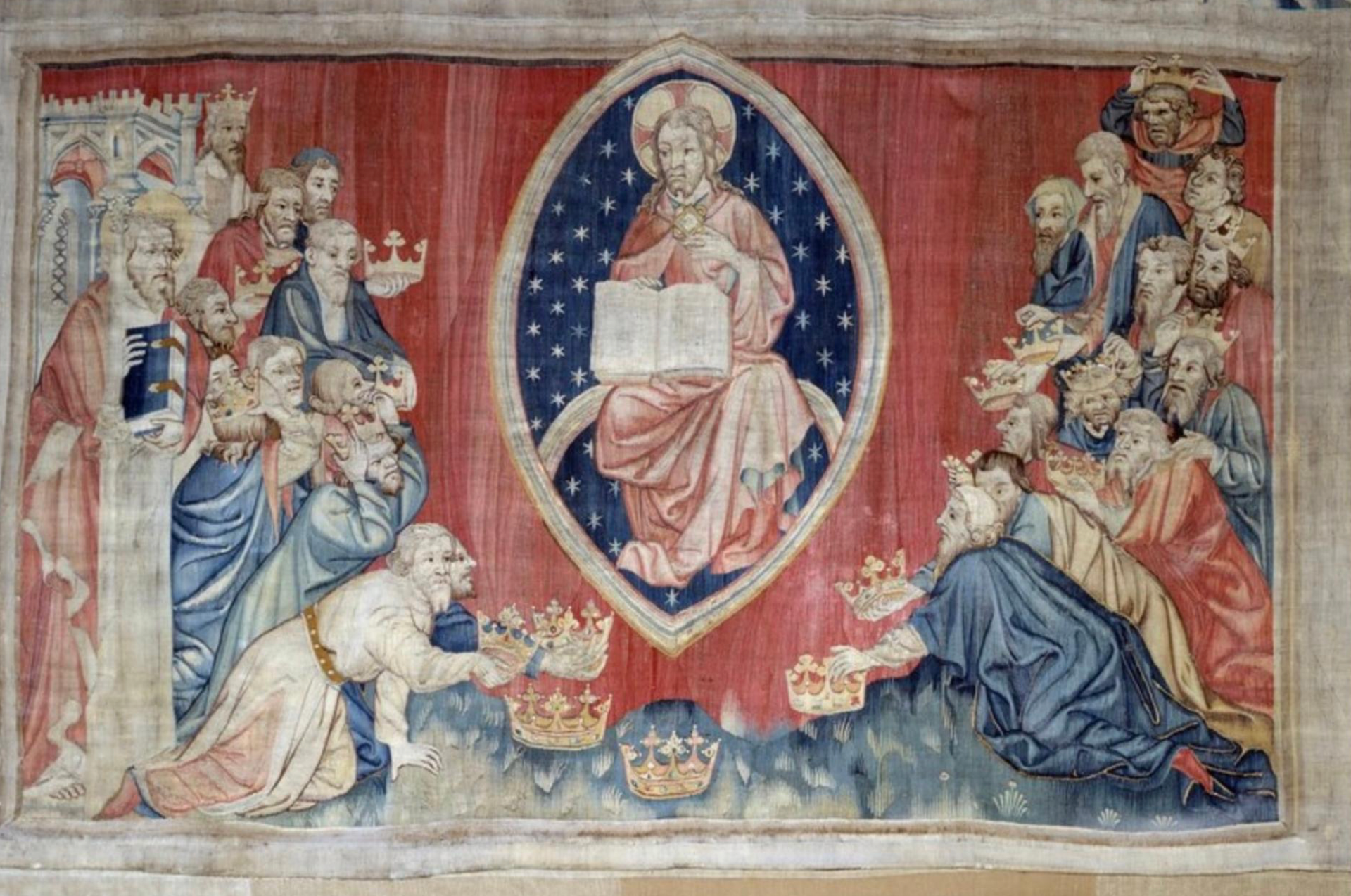
In the year that King Uzziah died, I saw the Lord sitting on a throne, high and lofty; and the hem of his robe filled the temple. Seraphs were in attendance above him; each had six wings: with two they covered their faces, and with two they covered their feet, and with two they flew. And one called to another and said:
‘Holy, holy, holy is the Lord of hosts;
the whole earth is full of his glory.’
The pivots on the thresholds shook at the voices of those who called, and the house filled with smoke. And I said:
‘Woe is me! I am lost, for I am a man of unclean lips,
and I live among a people of unclean lips;
yet my eyes have seen the King, the Lord of hosts!”
Then one of the seraphs flew to me, holding a live coal that had been taken from the altar with a pair of tongs. The seraph touched my mouth with it and said:
‘Now that this has touched your lips,
your guilt has departed and your sin is blotted out. ’
Then I heard the voice of the Lord saying,
‘Whom shall I send, and who will go for us?’
And I said, ‘Here am I; send me!’
(Continued in the sermon...)
Sermon
Reign of Christ Sunday
[1]
Does History Repeat Itself (All Over Again)?
Uzziah was one in the handful of good kings. King Uzziah, like King David, lived under the law of Torah, [2] a king who chose faithfulness. The four "good kings” came from the southern kingdom of Judah. As a Southerner, let me point out that not a one of those northern yankee kings were worth a plug nickel. [3] After 52 years of his relatively prosperous and peaceful reign, King Uzziah’s death set an already-divided nation on the road to catastrophe. Prophesying trouble ahead, Isaiah, the son of Amoz, began writing an astonishing testimony that shapes our world to this day. As soon as Uzziah died, Team Corruption took over. They made shady deals with enemy armies. They deported whole categories of people from Judah to Samaria.
Into God’s Presence
Notice the first verse. It happened in the year the unravelling began. Isaiah’s vision of God, in the Temple, sporting a skirt so elaborate Isaiah had to step around it or maybe stand on it—a train that fills a Temple. And in one sentence, we leave the physical world to step into the presence of all that is holy. God’s seraphs are fiery flying creatures, Scholar Robert Alter warns that the Hebrew here implies the seraphs could be flying snake-angels. Each seraphs has three sets of wings, hovering above God, like three-propellered drones. Cool and awful.
A Controlled Burn
Isaiah hears them singing sanctus, sanctus—holy, holy, holy is the Lord of armies. Then Isaiah’s meltdown, “Woe is me! I am lost….” More like, “I can’t even with all this!” ‘I’m not worthy of this, and my people are just as bad, but now I stand in the presence of God.’ Then, the flying snake [4] angels, still on fire mind you, choose the perfect piece of coal, one that will burn away all of Isaiah’s self-doubt and sin. A purifying. In Alexander Pushkin’s poem [5] on this passage, the seraph rips out the prophet’s heart and grinds in the burning coal to replace it. [6] Isaiah’s vision is sacred and brutal. Can we find value in pain? Blessings in horrific situations? Hearing God’s call, like Isaiah, always involves some kind of discomfort. The apocryphal book of Ecclesiasticus [7] warn us that if we aspire to serve God, prepare for an ordeal. [8] Then Isaiah replies to the Divine, “Here I am, send me.” or “Behold me and send me.” Behold, you’re getting all of my talent and all of my shortcomings, my faith and my misgivings. You behold me, God. What you behold is what you get.
Our Narrative Lectionary [9] says we should stop here—at “here I am, pick me”—but that’s too easy an ending. Renewing my personal commitment to do everything the hard way, let’s continue and discover more about God’s call to Isaiah.
Isaiah 6 (continued). And he said, ‘Go and say to this people:
“Keep listening, but do not comprehend;
keep looking, but do not understand.”
Make the mind of this people dull,
and stop their ears,
and shut their eyes,
so that they may not look with their eyes,
and listen with their ears,
and comprehend with their minds,
and turn and be healed. ’
Then I said, ‘How long, O Lord? ’And he said:
‘Until cities lie waste
without inhabitant,
and houses without people,
and the land is utterly desolate;
until the Lord sends everyone far away,
and vast is the emptiness in the midst of the land.
Even if a tenth part remains in it,
it will be burned again,
like a terebinth (tree) or an oak
whose stump remains standing
when it is felled.’
The holy seed is its stump.
Faith the Nation
God wants the nation to repent, or be purified (by fire). The stump, the fire and the desolation are metaphors that offer God’s people a clean slate, opportunities for God to do a new thing—in other words, there is hope amidst catastrophe. Through faith, we can see hope even in a stump! I got a little “stumped” by this passage. So, I called on my friend, Cantor Sharon Bernstein at Congregation Sha’ar Zahav. She says:
For me, it comes down to the meaning of [verses] 9 and 10. Are the people being externally prevented from seeing, hearing, and understanding? Or are these verses reflecting a reality in which people are…unable to see, hear, and understand, and that they must overcome their own blocks towards returning to God? [10]
Brilliant questions. What is blocking the nation from returning to God?
You Gotta Have Heart
Roger Nishioka tells the story of his Jewish friend who greets him saying, “I’ve been thinking about you” while pointing to her heart. Try that. The word lev is the seat of the intellect. [11] Verse 10 means “Make the heart of this people heavy.” Fatten them up on God’s truth—a good image for Thanksgiving. You can feed them my spiritual food, but they won’t eat it, says God.They will look and not see. Hear and not listen. They have chosen—or something has made—their hearts impervious to God. I recently read a Quaker minister’s description of a particular politician that went something like, “I know he’s a child of God, but he hides it so masterfully!” The same could be said for Uzziah’s successors, Ahaz in Judah, and Pekah in the north. Hard-hearted, little Grinch hearts, in need of God’s nourishment. Defiant and willful. Their hope is in themselves, Isaiah writes in chapter 5. No wonder they’re mean and vulgar and reckless.
Hope & Memory
Hope is a hard sell to a people drunk [12] on power. They think they’re heroes. They are self-congratulatory. Their group-vengeance “buzz” blocks them from caring about the rights of others or the rules others live by. They are the leaders, writes queer Bible commentator Timothy Koch, who “incite a crowd to protest in places where abortions are performed, [or] to break the windows of Jewish [or Muslim] businesses” [13] and then disavow responsibility. These are the same kind of leaders who are going to ban the highest-ranking transgender person ever elected by the people of this country from using the bathroom in the United States capitol. [14] Later on, when their followers kill and bomb, they will avoid the cameras or act surprised. You can tell them, says God, but they won’t listen. Show them, but they continue to choose not to see. They are proud of overcoming the inconveniences of right and wrong. [15]
All of this has happened before. Isaiah “names ancient…strategies of manipulation and control that are in evidence today, tactics frequently employed by those in religious and/or governmental power.”[16] But Isaiah, like Harvey Milk, knew, “You gotta give em hope.” So many of you have come to me hopeless in the past week. Thank you for trusting me with your hopelessness. You got me to thinking, what is hope anyway? First, hope is not insane optimism in the face of abject evil. Hope is not our well-meaning friends cheering us up when we’re down. Joan Chittister writes that hope is not made of denial. Hope is made of memory. [17] Isaiah’s memories— they’re in the book—show us how God’s people made it through the Assyrian mess, the Babylonian Exile, all kinds of troubles. In Chapter 8, we see that they made it through conspiracy theories. Hope is alive in the memory of our ancestors. We honor them with our perseverance and our choice: hope. Our leaders have promised us [18] that the coming years will not be easy. Please make sure you have learned all of the assigned material—prophecy and gospel, Psalm and epistle—because it will all be on the test.
“Hope” by Jason Robert Brown:
I come to sing a song about hope.
I’m not inspired much today, but even so,
I came out here to sing a song
So here I go.
I guess I think that if I tinker long enough
One might appear,
And look! It’s here.
One verse is done.
The work’s begun.
I come to sing a song about hope
In spite of everything ridiculous and sad
Though I’m beyond belief depressed, confused and mad.
Well—I got dressed.
I underestimated how much that would take.
I didn’t break, until right now.
I sing of hope—and don’t know how.
So maybe I could substitute “strength”
Because I’m strong, I’m strong enough.
I got through lots of things I didn’t think I could,
And so did you.
I know that’s true.
And so we sing a song about hope,
Though we can’t guarantee there’s something real behind it.
We have to try to show our daughters we can find it.
And so today—when life is crazy and impossible to bear—
It must be there.
Fear never wins.
That’s what I hope.
See, I said “hope.”
The work begins.
About The Bulletin Cover
(San Damiano Cross, image)
Recently, I participated in an amazing queer [19] clergy retreat, walking in the footsteps Saints Francis and Clare of Assisi… in Assisi…Italy! How blessed am I. The cross on today’s bulletin cover (pictured above [20] in this printed sermon) was created anonymously, around a thousand years ago. This San Damiano Cross is the icon Francis would wrestle with, all Saturday-night long, preparing for Sunday morning worship. Icons are neither drawn nor painted; icons are written testaments. This icon is called The Book of the Cross, a medieval roadmap for a faithful journey. Locate the shells. They remind us that this life as a pilgrimage. See them? They form the cross’s border. See how the border is left open. So, at the foot of the cross, here is where we enter—in darkness—the dark of a cave, the place of no foreseeable future, or a blank slate, or the dark of the womb, where we anticipate new life. This darkness is essential place, where we walk by faith and not by sight, a darkness where hope isn’t obvious. Here, we must trust. Let God be God. This is terrifying for us control freaks and people who fear change. Come on in to this holy darkness. We’ll be together. Before this cross reading ends, look at his face. That is not a suffering face. It that peace? Perhaps a little hope? Christ’s suffering is accomplished, and a new life is begun. He is looking for you, believing in your potential. The Sprit of the Lord is upon him, and he commands us: to bring good news to the poor, to bind up the brokenhearted, to proclaim freedom to prisoners, to proclaim the year of the Lord’s favor, and the day of vengeance of our God, to comfort all who mourn…[21]
[1] See my beginner’s guide to the San Damiano Cross “The Book of the Cross” (graphic) at the end of this sermon.
[2] Uzziah's disobedience to the law might have brought on his demise. He contracted leprosy after violating the separation of priestly/kingly powers.
[3] I mean this as folksy Bible nerd humor. Some of my best friends are yankees.
[4] Sweet dreams! And remember, sometimes a flying snake is just a flying snake.
[5] A. Pushkin’s 1826 poem “The Prophet” < https://max.mmlc.northwestern.edu/mdenner/Demo/texts/prophet.htm>
[6] Robert Alter, The Hebrew Bible: A Translation with Commentary, Volume 2: The Prophets, (New York: W. W. Norton & Company, 2019), 641.
[7] Ecclesiasticus, aka Sirach, 2:1 < https://www.biblegateway.com/passage/?search=Sirach 2&version=NRSVUE>
[8] This rooster symbolizes the trials of following Jesus in The Book of the Cross (San Damiano Cross). The rooster is almost hidden, hard to make out, but it lives in the right-side border, near Jesus’ feet. It symbolizes not only the begging of God’s “new thing” but, also as the denial and sabotage experienced by the burgeoning Jesus Movement (“the cock crows three times”). This can help to put troubling times and, more specifically, the promised sabotage of our way of life, into a larger perspective. Think of all we’ve been through, all that Jesus went through. We’ve got this.
[9] What is the Narrative Lectionary? < https://www.workingpreacher.org/narrative-faq> We are currently following the Narrative Lectionary at Calvary.
[10] A quote from Cantor Sharon Bernstein’s very insightful written response.
[11] Also from Cantor Bernstein. .
[12] See Isaiah, chapter 5.
[13] Timothy Koch in The Queer Bible Commentary 2nd Edition (London: SCM Press, 202
[14] I can’t even.. < https://gomag.com/article/trans-congresswoman-sarah-mcbride-is-banned-from-capitol-hill-bathroom-and-shes-not-fighting-it/>
[15] Read Isaiah, chapter 5.
[16] Koch, Queer Bible Commentary, 347.
[17] Joan Chittister “Hope Is Not For Easy Times” <https://joanchittister.org/word-from-joan/hope-not-easy-times>
[18] Tucker Carlson’s MSG speech < https://singjupost.com/full-transcript-tucker-carlson-speaks-at-msg-trump-rally/>
[19] Although some served in alternative contexts, like me, most of the participants were from my denomination of ordination, the Metropolitan Community Churches, the original interfaith movement of religious equality. < https://insidemcc.org/about-mcc/mcc-history/>
[20] San Damiano Cross (“The Book of the Cross”) <https://upload.wikimedia.org/wikipedia/commons/3/31/Kruis_san_damiano.gif>
[21] Isaiah 61, alt. by the preacher