
Sermon 09.20.2026: Journeying By Stages
Occasionally, our paths are clear and direct. Most often, though, my path has been circuitous, with fits and starts. It's easy to get bogged down and discouraged when the path is not straight and clear. We'll hear of Abram's journey by stages, and consider where God is in the midst of our own journeys.
Scripture
Genesis 12:1-9
Now the Lord said to Abram, ‘Go from your country and your kindred and your father’s house to the land that I will show you. I will make of you a great nation, and I will bless you, and make your name great, so that you will be a blessing. I will bless those who bless you, and the one who curses you I will curse; and in you all the families of the earth shall be blessed.’
So Abram went, as the Lord had told him; and Lot went with him. Abram was seventy-five years old when he departed from Haran. Abram took his wife Sarai and his brother’s son Lot, and all the possessions that they had gathered, and the persons whom they had acquired in Haran; and they set forth to go to the land of Canaan. When they had come to the land of Canaan, Abram passed through the land to the place at Shechem, to the oak of Moreh. At that time the Canaanites were in the land. Then the Lord appeared to Abram, and said, ‘To your offspring I will give this land.’ So he built there an altar to the Lord, who had appeared to him. From there he moved on to the hill country on the east of Bethel, and pitched his tent, with Bethel on the west and Ai on the east; and there he built an altar to the Lord and invoked the name of the Lord. And Abram journeyed on by stages towards the Negev.
Sermon
Our passage this morning is the first of a few descriptions of Abram's covenant with God. In chapter 15, when God comes to him, this time in the dream, Abram asks for clarifying details. “Yes, God, I remember the promise. But my wife still has not gotten pregnant and we are not young. How is this going to work out?”
For the authors of Genesis, I think we are supposed to question Abram’s faith, or his faithfulness, because of his questions to God. And I do see their point. If God actually spoke to us, wouldn’t that, shouldn’t that, be enough for us to trust the promise?
But Abram and his wife Sarai are people like us. We can understand only what we understand. We learn about things in stages. If having descendants that number more than the stars in the sky is the promise, shouldn’t that mean we have at least one child first?
We are like Abram and Sarai. We want to take the promise and then write the story ourselves. And I encourage you to read the next chapters in Genesis this week because next week the story skips ahead quite a bit and I’d hate you to miss the story of Abram mucking it up as he tries to control the narrative. They will both go through name changes, becoming Abraham and Sarah, as they learn to trust in the promise of God even when they can’t see where the journey will take them.
In the New Testament, the Book of Hebrews says this about them, in chapter 11:
Hebrews 11:8-12
By faith Abraham obeyed when he was called to set out for a place that he was to receive as an inheritance; and he set out, not knowing where he was going. 9By faith he stayed for a time in the land he had been promised, as in a foreign land, living in tents, as did Isaac and Jacob, who were heirs with him of the same promise. 10For he looked forward to the city that has foundations, whose architect and builder is God. 11By faith he received power of procreation, even though he was too old—and Sarah herself was barren—because he considered God faithful who had promised.* 12Therefore from one person, and this one as good as dead, descendants were born, heaven and as the innumerable grains of sand by the seashore.
The author of Hebrews could tell the story of Abraham more clearly because they had the luxury of hindsight. I know that is true in my own life too, as I’ve journeyed by stages. It is when I look back that I can see the path clearly. When I look forward, I often miss it. Almost everything I value and love about my life happened despite me, not because I trusted God the first time around.
When I was younger, I would have been surprised to discover I would marry young and love being a mother. I would have never expected I would become a pastor, or that being a pastor would take me one day to San Francisco. I thought I would be a hard hitting investigative journalist or maybe a History professor.
Has the journey of your life brought you exactly where you thought it would take you? I suspect not.
Abram journeyed in stages from modern day Turkey, near the border of Syria, down toward the Negev, near the Southern end of modern day Israel. Pretty big journey for a guy with an un- air conditioned camel. When we read on the text, we discover it didn’t work for Abram as he planned either. “Now there was a famine in the land. So Abram went down to Egypt to reside there as an alien, for the famine was severe in the land.”
Abram becomes a refugee, fleeing a famine, in order to live into the promise of blessing.
God promises Abram he’ll be a blessing. God doesn’t promise Abram it will be easy. Or successful in worldly terms. Only that he’ll be a blessing.
In the Hebrew, it’s an imperative. Abram has no choice. Imagine the tone a parent uses when they tell their children they WILL clean their rooms.
You WILL BE a blessing.
And as you read through the narrative of our patriarchs, you see, again and again, that the promise holds true no matter how dire the situation appears to be.
Despite the brokenness of our lives, despite the way our dreams don’t turn out as we intend them to, we WILL BE a blessing.
We can look around at the world and see plenty of people who are actively trying not to be a blessing to other people right now. Without going too deeply into the headlines, or mentioning people by name, I think we can see how it looks when people get lost as they journey by stages. They can end up in all the wrong places.
And maybe you thought you’d be in a bright meadow but find yourself in a place that feels like a location from the story the Princess Bride—a fire swamp with rodents of unusual size, the cliffs of insanity or a pit of despair. When that happens, often because we’ve tried to control the narrative ourselves and muck it up—as Abram did—we have to make some choices. Do we want to double down in our mistakes and cause harm to ourselves and others OR do we want to correct course, leave the fire swamp, and turn back toward blessing?
We’ll see this again and again in the story of scripture and in the stories of our own lives.
I hope you’ll notice the way God remains faithful, even when our ancestors in faith were not. God’s faithfulness needs no renewal. Human faithfulness to God needs constant renewal.
We need to hear the promise again. And again. And then again.
Abram journeyed in stages, we’re told.
He did not take a direct flight to his final destination. We live in a world where we can get on a plane and be halfway around the world tomorrow. Or if we were to drive, we have podcasts and playlists, climate control, and comfortable hotels where we can rest along the journey.
To journey in stages though, is a different way to travel. Packing up your camel every morning, cleaning up the campsite, making sure you have water and food for the next stretch of desert you’re crossing. You have to travel light when you journey by stages.
I think that is true both literally and metaphorically. In the past year, my husband and I downsized our lives, selling our family home and buying a condo. And it was both heartbreaking and liberating. I cried to let go of much of my children’s baby clothes, artwork, and toys, let alone the things from my own childhood I’d been carrying around for 50 years.
And I still have too much stuff, I know. But I feel a lot lighter now without most of what we had. I donated fabric I had bought to make curtains for a house we lived in in Albuquerque.
In 1994.
I moved that fabric across the country 4 times. And if I’m honest about it, a small part of me still regrets letting it go. It was cute fabric!
When we journey by stages, on our way to being a blessing, we have the opportunity to let go of that which is no longer serving us. What are we carrying around that we can let go of so the next part of the journey will be easier to make?
Maybe it is something physical, like my adorable gingham fabric that had the watermelons on it. Maybe it is a judgment of ourself or of others that has become too heavy to carry. Maybe it is shame we picked up along the way. Maybe it is doubt about our own giftedness. Maybe it is a prejudice or judgment we were taught.
What are we carrying around with us that is making the journey harder than it needs to be?
Maybe we need to let go of trying to please our ancestors. My grandmother made this tea cozy. I don’t need a tea cozy but would she think I don’t love or remember her if I let it go? Think of when the phrase, “but we’ve always done it that way” has been a burden as you journey into the future.
We’ve shared this quote before, but it’s worth hearing again, from Adam Grant: “It’s more important to be good ancestors than dutiful descendants. Too many people spend their lives being custodians of the past instead of stewards of the future. We worry about making our parents proud when we should be focused on making our children proud. The responsibility of each generation is not to please our predecessors—it’s to improve conditions for our successors.” ― Adam M. Grant, Hidden Potential: The Science of Achieving Greater Things
And there is nothing wrong with making our parents proud, but to journey by stages, to be a blessing for future generations, you can’t always—or only—look backwards. We do look backwards to see where we’ve come from and to chart our direction. But we have to look forward to find the next path.
Abraham is not my favorite of the patriarchs in the Bible. He tries to pass off his wife as his sister (more than once!) to avoid personal risk. He’s a complicated character. But in the end, he is faithful to the promise and his journey does get him to the destination in stages.
Genesis calls Abraham a sojourner. The word in Hebrew means to sojourn, dwell temporarily, or live as a foreigner without permanent political rights or full security. And because it was the political status of the person with whom God established the covenant, it becomes enshrined in biblical law as someone you protect.
Listen to this from Deuteronomy 10:
17For the Lord your God is God of gods and Lord of lords, the great God, mighty and awesome, who is not partial and takes no bribe, 18who executes justice for the orphan and the widow, and who loves the sojourners, (the strangers), providing them with food and clothing. 19You shall also love the stranger, for you were strangers in the land of Egypt.”
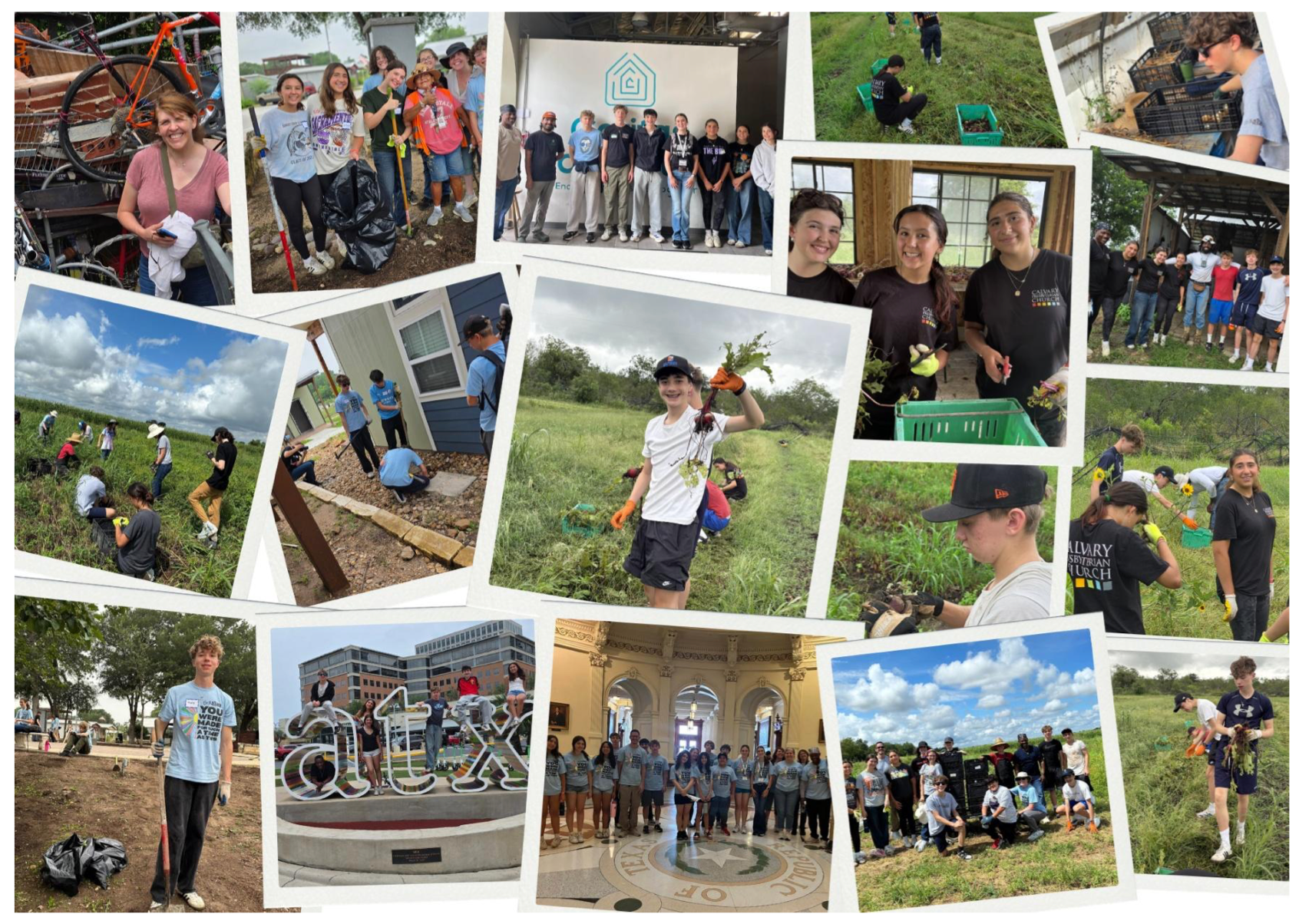
There are a lot of commands in the Bible to care for the stranger, to feed the hungry, to provide for widows and orphans. We do it because they matter to God. We do it because we were once strangers ourselves. It’s a promise that looks backward to direct us toward being a blessing in the future. Today there is a team of people from Calvary in Watsonville, worshiping with sojourners and farmworkers, learning about their journeys as we work on our own.
I think when we look back on our journey, we tend to remember the good parts—Abraham had many flocks and became a patriarch. We tend to forget the difficult parts—Abraham was a sojourner who relied on the kindness of others to make the journey by stages.
When you only see the good parts of the past, it makes it harder to see the hopeful path for the future. If I remember that my grandfather, a Scottish immigrant who came here through Canada, owned a bus line in Southern California, I can buy into the narrative that anyone can pull themselves up by their own bootstraps. But if I forget that he lost it in the economic crash of 1929, and that my family survived the depression and alcoholism he later struggled with because of the kindness of people who left groceries on the back porch, it’s going to be harder for me to assess my own challenges, and to allow people to help me when I need it.
If we tell our children only the stories where we’re the hero or get everything right, but leave out our disasters and mistakes, how are they to navigate their own messes?
The Book of Genesis gives us the whole mess. I’m grateful for that.
Our instruction to be a blessing is a part of how we journey through life. As we think about what we need to let go of to make the journey easier to navigate, I pray we will seek community so that we can share each other’s burden and make the path easier to travel.
Here’s a blessing for us from Kate Bowler:
Blessed are you who don’t have
all the right answers.
You who realize that “I don’t know”
is the best response and posture for now.
You who lean in, unafraid to learn
and change and be wrong along the way.
Blessed are you,
stretched and pressed and pulled
by the uncertainty,
deciding not to stay the same
because we are not who we were.
We have been pulled into the unknown
without our permission.
But the challenge is the same:
reveal truth in love in the midst of seeming chaos.
Blessed are you who realize that
community can help see truth more fully
even if your chin has to be turned gently toward it.
Being fragile in a world of hammers
takes courage
to be wrong
to learn something new,
to choose humility and kindness
over being right.
May we be a people who don’t have it all together
(and who are done posturing).
Curious, hopeful, courageous.
Amen.