
Sermon 12.28.2025: Jesus, A Refugee in Egypt
Not long after the birth of Christ, King Herod's fragile ego led to the slaughter of innocents. Jesus and his family, however, were able to escape this massacre by seeking refuge in Egypt. When we welcome immigrants and refugees, we welcome Jesus who knew what it meant to be displaced and how it felt to have to leave home in search of safety. This Christmas season, let us welcome the brown-skinned refugee whose birth changed the world!
Scripture
Matthew 2:13-23
Now after they had left, an angel of the Lord appeared to Joseph in a dream and said, “Get up, take the child and his mother, and flee to Egypt, and remain there until I tell you; for Herod is about to search for the child, to destroy him.” Then Joseph got up, took the child and his mother by night, and went to Egypt, and remained there until the death of Herod. This was to fulfill what had been spoken by the Lord through the prophet, “Out of Egypt I have called my son.”
When Herod saw that he had been tricked by the wise men, he was infuriated, and he sent and killed all the children in and around Bethlehem who were two years old or under, according to the time that he had learned from the wise men. Then was fulfilled what had been spoken through the prophet Jeremiah: “A voice was heard in Ramah, wailing and loud lamentation, Rachel weeping for her children; she refused to be consoled, because they are no more.”
When Herod died, an angel of the Lord suddenly appeared in a dream to Joseph in Egypt and said, “Get up, take the child and his mother, and go to the land of Israel, for those who were seeking the child’s life are dead.” Then Joseph got up, took the child and his mother, and went to the land of Israel. But when he heard that Archelaus was ruling over Judea in place of his father Herod, he was afraid to go there. And after being warned in a dream, he went away to the district of Galilee. There he made his home in a town called Nazareth, so that what had been spoken through the prophets might be fulfilled, “He will be called a Nazorean.”
Sermon
The first trip I took as a new mom was when our oldest was just 2 months old. And believe it or not, part of the reason I made that trip, from Minnesota to California, was to interview, here in person at Calvary.
Mike was clerking for a judge at that time, and, as a government employee, hadn’t accrued nearly
enough vacation days to go with me the whole time, so I made the trip out alone.
Stroller, car seat, baby in a carrier, diaper bag with me, all the other luggage checked and on its way,
this tiny new human and I took our first trip together—nearly 2000 miles across the country, landing at SFO without much of a hitch. It would be the first of many trips. In fact, that first year of Austin’s life, he was on 25 different planes, traveling with me to meetings and conferences and to visit family and friends. It was mostly all domestic travel, but also to Hong Kong and back.
We were lucky that, for the most part, he was a good traveler, meaning he slept well in the baby carrier,
and all he really needed was to be nursed and changed at the right times. Traveling with little ones, though, is always an added challenge, right? But it seemed worth it, and it seemed worthwhile at the time. That being said, we weren’t fleeing from violence or for our lives. And we always had a place to call home, even when we were changing homes from St Paul to San Francisco.
So, it’s hard for me to imagine the plight of the Holy Family, already in a liminal place in Bethlehem, right?
That’s not their home now. Then having to escape by night and in secret to Egypt.
Sadly, we know, however, that Jesus wasn’t the first baby to flee violence and genocide, and he certainly wasn’t the last. These past few years, I’ve found myself reading several memoirs and stories
by Vietnamese and Cambodian refugees.
2025 marked the 50th anniversary of the fall of Saigon and the first Vietnamese refugees’ arrival in the United States. I’ve read “Ma and Me” by Putsata Reang; “Owner of a Lonely Heart” by Beth Nguyen;
“On Earth We’re Briefly Gorgeous” by Ocean Vuong; “Slow Noodles” by Chantha Nguon …
And it helps me understand a bit, but if I’m honest, I’m too afraid to really put myself in their shoes.
As a mother of three, or just an empathetic human being, the horror and fear of running from home with my children feels too close and too scary and too heart-rending to allow myself to truly imagine it.
But that’s privilege speaking, isn’t it?
Because we know, parents have done it for millennia, and still today, parents run with their babies because staying most certainly means death.
Warsan Shire in their poem
“Home” writes:
no one leaves home unless
home is the mouth of a shark
you only run for the border
when you see the whole city running as well
your neighbors running faster than you
breath bloody in their throats…
you only leave home
when home won’t let you stay…
you have to understand,
that no one puts their children in a boat
unless the water is safer than the land
Warsan Shire first began writing these words after visiting
with young Somali refugees.
The poem reflects the choices refugees must often make and Shire's own disgust with the dehumanization of them in her own country of England. I first read these words in 2015 when the first stanza became a rally call for refugees and those advocating for them. And as my heart broke for Syrian mothers, carrying their infants across borders as they fled for their lives. What I really want is for tyrants like Herod to stop their maniacal behavior. Their greed and hunger for power force people to flee their homes or sacrifice their children.
Erna Kim Hackett calls Herod, “an insecure leader who panders to empire and feigns interest in religion to try and secure his authority… Herod reveals how power twists a person, how it turns faith into theater and people into pawns.”
But we wouldn’t know anything about that, would we?
Friends, Herod is every leader who will do anything to amass more power and wealth. He’s the one
redacting documents that implicate him in the harming of children. He’s the one demeaning any leader that has gone before him, or name-calling journalists doing their job. Herod is incapable of compassion or kindness, unless it is for his own benefit. Herod is a narcissist, obsessed with power. And anyone, even a newborn child, can be viewed as a threat.
I long for a world free of Herods. A world free of their fragile egos and petulant power struggles.
I am so tired of people dying, going hungry, and getting deported at the whims of these power-hungry, selfish leaders, and their pathetic grabs at any semblance for authority and control.
Enough already!
Mary sang of scattering the proud, sending the rich away empty, and toppling corrupt regimes while
pregnant with the Christ child.
And her song continues today until the powerful are truly brought down, unable to ever again harm the most vulnerable and marginalized among us.
Our Advent theme this year was “Soon and very soon,” and indeed, that has been my prayer.
But until the day that prayer is fully realized, we are reminded by Rev Kim Hackett that:
“The [Christmas] story opens with a tyrant on a throne and the Creator in the arms of a refugee woman.
Only one of them is worth following.
God shows up on the margins, not in the halls of power.”
It is worth noting then, that anywhere there is a Herod, God is with those who are oppressed by that Herod.
Anywhere there is weeping due to the policies or executive orders of Herod, God is with those who weep.
Anytime someone must leave home in fear for their lives, God is with that weary traveler.
And not only is God with that traveler, but God was, and still is, that traveler.
That is the good news of the gospel. Hope and love are born in Bethlehem.
But they are not found in a palace or on the throne. They are found in a manger.
If the powerful didn’t have the ability to ruin and destroy the lives of so many, I would pity them.
Herod never got to see the baby Jesus, never got to experience the miracle of his birth, never got to be
transformed and changed forever, like the shepherds and the magi who came and brought homage.
He never felt the joy of hope and love found at that manger. And he lived his life in fear and pathetic
longing. I
almost feel sorry for him, until I remember that he slaughtered the innocents and that his tyranny killed so many.
It’s true that God still loves
the Herods of the world, but I confess it’s harder for me to do so.
And while God does indeed love all people, I believe God is not found in the Herods of the world.
Rather, God is found in the scared families fleeing their homes, seeking refuge in far away lands.
Pope Pius XII (12th) said in 1952:
“The Holy Family of Nazareth, fleeing into Egypt, is the archetype of every refugee family.
Jesus, Mary and Joseph, living in exile in Egypt to escape the fury of an evil king, are, for all times and all places, the models and protectors of every migrant, alien and refugee...”
[1]
Friends, let us not be mistaken. God is not with the tyrants.
God is with the refugees and all those on the margins.
The Lord, Emmanuel, the Word made flesh, was a refugee himself, escaping to Egypt for fear of his life.
And every time we welcome the stranger or the immigrant, we welcome God.
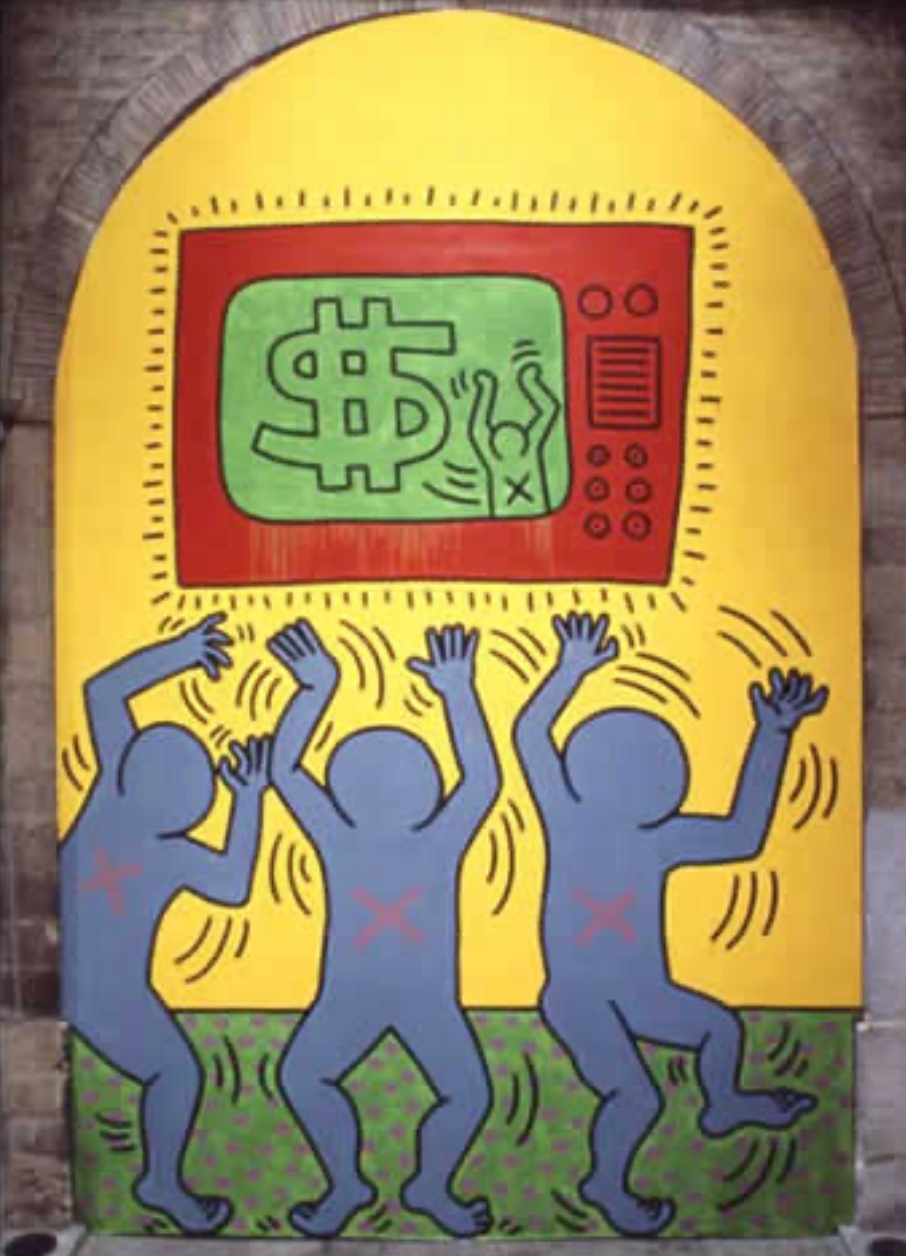
That’s why this sign on the front of our bulletin hangs outside the church today. Because we want to be a people who welcomes God among us. Every time we welcome the stranger or the immigrant, we welcome God. Every time we resist the powers and principalities that slaughter the innocents, be it in a school shooting, a detention center, or by public decree, we welcome God. Every time our choices reflect our hopes rather than our fears, we welcome God. Every time we put aside our ego and our selfish greed, we welcome God.
Friends, will we welcome God into our lives and into the world this day? Because
that’s what Christmas is about.
Meister Eckhart famously said, “What good is it to me if Christ was born in Bethlehem 2,000 years ago
if he is not born today in my own heart?”
May Jesus be born to us today.
May Jesus be born
in us today.
Deitrich Bonhoeffer asks: Who among us will celebrate Christmas correctly? Whoever finally lays down all power, all honor, all reputation, all vanity, all arrogance, all individualism beside the manger…”
May it be so and may that be us today and every day forward. Amen.
[1] Pope Pius XII, “Exsul Familia Nazarethana” (1952)
Post-Sermon Reflection:
A Manger in the Mud and the Muck, by Jon-Marc McDonald
New York is filled with those locked in the prison of their own minds, roaming free on the streets. They scatter about like litter in the wind, going in no clear direction but seemingly always going. Some become familiar faces, a regular part of a commute or fixtures at street corners or junkies that gather at the park at the twilight hour chasing the magic that disappeared long ago. After a while, they’re simply scenery, movable objects strewn about, another obstacle to step over or around or avoid. If
you live here long enough you find your own way to ignore the blight, lest the misery prompt you to do something about it.
And then there’s him.
He lives in my neighborhood, though by all appearances he has nowhere to actually live at all. I see him most often in the tunnel at the 190th Street A train station. He's slight, frail, shuffles his unshod feet along the shards of broken ground. His tattered black shirt and his tattered black pants match his weathered black skin. His lips are cracked, his hair an unkempt splay of wiry grey. He beats his palms against his temples and speaks to himself in a language understood only to him. He’s been around since I moved to the neighborhood over five years ago, always wearing the same clothes, no matter the
season, wending his way through the tunnel, in and out again.
On occasion, my mind drifts to his past, to a time before the present untold torment. I wonder who his parents were, if they're still living, if they know their son is no longer tethered to the realities of this life? I wonder if he ever felt the touch of another, ever experienced the great unknown of lust and love and everything in between? Did he ever have a boyfriend or a girlfriend, hold a job, run a race? What’s his favorite food, his favorite song? His birthday? Indeed, what is his name?
Where’s his friend from a time gone by, are they aware he has no shoes, that he sleeps somewhere between the park bench and outer space? Do they know their friend from yesterday is lost in a world unto his own today? Did they witness the great unraveling, the descent to his current location beyond the reach?
Today I realized I had not seen him for a while. I can’t place the exact time I saw him last but it is clear he is no longer around. My heart sank. I can't help but wonder if he was taken away, against whatever remaining will he has, to be warehoused far from our collective conscience. Or worse, that his battered body finally surrendered to a cruel world that never recognized him as a being worthy of life in the first place.
I can't help but consider that his presence made more than a few uncomfortable. I can’t help but admit that I was among those few.
The fact is, his presence in my life revealed more about me than it did him. For five years, in order to shield myself from the reality of his humanity, I had to strip him of it. Notwithstanding the occasional lapse of curiosity into his past, I had to tell myself a story that is as familiar as my own, one that includes the usual narratives meant to justify my inaction, the ones that begin with “if only”…he made better choices…and there’s surely addiction…he got an education… he tried harder…before the snap…there was a chance…he didn’t take it.
Winter finally arrived in New York City, just days before Christmas. Even insanity’s deep unknowns can’t numb the bitter reality of winter’s impending assault. If he is still around – an unlikely ‘if’ – someone saw him today for the first time. And today they were faced with the choice that every single person is faced with upon first sight of him, a choice that acknowledges his full humanity or damns him to the shadows, a choice to accept his perfect brokenness or abjures his broken perfection. It is this
choice that informs us as to who we are, not to who he is. For all our lofty talk and pride in our own compassion, for all our outrage that our neighbors are not welcoming in the refugee or that our opponents aren’t doing enough for the disenfranchised, it is the decision that we face when we face the stranger among us that speaks to who we are, and usually our decision proves our words are nothing more than hollow comfort to a world in desperate need of action.
He was my refugee, the stranger I couldn’t crack open my heart long enough to know, the outcast trying to make his way back, chained to a devastation he could not control, a man whose very existence screamed for help yet couldn’t articulate that he needed any.
And I failed him.
In a few days, much of the world will stand still to celebrate a birth. Whether you believe or not, there is no denying the fact that the season hinges on a story so removed from the realm of possibility, one must be foolish or faithful or both to believe it .
Regardless, I still cling to the story of Christmas. I still believe in its message. I am still moved by its power and awed by its great expectation.
But I am convinced that, above all, Christmas is a story about the marginalized and rejected. The majesty of Christmas is found in a manger awkwardly fitted in a stable between the dung and debris. The glory of Christmas is the outcast baby born in the mud and the muck.
If we can’t care for him in the filth of the manger, we can’t claim Him at the foot of the cross. If we can’t feed him in the shelter, we can’t find Him in the heavens. If we can’t comfort him in the asylum, we can’t carry Him to the tomb. If we can’t welcome him at our borders, we can’t receive Him in our hearts. If we can’t call him our brother, we don’t get to call Him our savior.
If Jesus is to be found anywhere this season, He will be huddled under the blankets on the city streets, He will be found in the hungry belly of the child who hasn’t eaten in days, with the man beating his temples and wandering around barefoot, next to the crack addict who needs just one more hit, holding the mother clinging to her dying child because she doesn’t know how to let go, arms wide open for those at our shores fleeing the violence of a far off land.
Because unto us a child is born.
Unto us, naked
Unto us, hungry
Unto us, battered and bruised
Unto us, imprisoned
Unto us, broken and alone
Unto us, addicted
Unto us, in tattered clothes,
Unto us, without any shoes
Unto us, either love wins every time or, unto us, the whole damn thing is a sham.