
Sermon 02.01.2026: Shallow Wells
We live in a world full of shallow wells, creating a thirsty, isolated world. There’s a lot of anxiety in the world, in the church, because we turn to those shallow wells and are never satisfied. Jesus offers the Woman at the Well living water. What would it take for us to leave our water jars by our wells so we can have our thirst slaked and our souls renewed with living water?
Scripture
John 4:1-42
Now when Jesus learned that the Pharisees had heard, ‘Jesus is making and baptizing more disciples than John’— although it was not Jesus himself but his disciples who baptized— he left Judea and started back to Galilee. But he had to go through Samaria. So he came to a Samaritan city called Sychar, near the plot of ground that Jacob had given to his son Joseph. Jacob’s well was there, and Jesus, tired out by his journey, was sitting by the well. It was about noon.
A Samaritan woman came to draw water, and Jesus said to her, ‘Give me a drink’. (His disciples had gone to the city to buy food.) The Samaritan woman said to him, ‘How is it that you, a Jew, ask a drink of me, a woman of Samaria?’ (Jews do not share things in common with Samaritans.) Jesus answered her, ‘If you knew the gift of God, and who it is that is saying to you, “Give me a drink”, you would have asked him, and he would have given you living water.’ The woman said to him, ‘Sir, you have no bucket, and the well is deep. Where do you get that living water? Are you greater than our ancestor Jacob, who gave us the well, and with his sons and his flocks drank from it?’ Jesus said to her, ‘Everyone who drinks of this water will be thirsty again, but those who drink of the water that I will give them will never be thirsty. The water that I will give will become in them a spring of water gushing up to eternal life.’ The woman said to him, ‘Sir, give me this water, so that I may never be thirsty or have to keep coming here to draw water.’
Jesus said to her, ‘Go, call your husband, and come back.’ The woman answered him, ‘I have no husband.’ Jesus said to her, ‘You are right in saying, “I have no husband”; for you have had five husbands, and the one you have now is not your husband. What you have said is true!’ The woman said to him, ‘Sir, I see that you are a prophet. Our ancestors worshipped on this mountain, but you say that the place where people must worship is in Jerusalem.’ Jesus said to her, ‘Woman, believe me, the hour is coming when you will worship the Father neither on this mountain nor in Jerusalem. You worship what you do not know; we worship what we know, for salvation is from the Jews. But the hour is coming, and is now here, when the true worshippers will worship the Father in spirit and truth, for the Father seeks such as these to worship him. God is spirit, and those who worship him must worship in spirit and truth.’ The woman said to him, ‘I know that Messiah is coming’ (who is called Christ). ‘When he comes, he will proclaim all things to us.’ Jesus said to her, ‘I am he, the one who is speaking to you.’
Just then his disciples came. They were astonished that he was speaking with a woman, but no one said, ‘What do you want?’ or, ‘Why are you speaking with her?’ Then the woman left her water-jar and went back to the city. She said to the people, ‘Come and see a man who told me everything I have ever done! He cannot be the Messiah, can he?’ They left the city and were on their way to him.
Meanwhile the disciples were urging him, ‘Rabbi, eat something.’ But he said to them, ‘I have food to eat that you do not know about.’ So the disciples said to one another, ‘Surely no one has brought him something to eat?’ Jesus said to them, ‘My food is to do the will of him who sent me and to complete his work. Do you not say, “Four months more, then comes the harvest”? But I tell you, look around you, and see how the fields are ripe for harvesting. The reaper is already receiving wages and is gathering fruit for eternal life, so that sower and reaper may rejoice together. For here the saying holds true, “One sows and another reaps.” I sent you to reap that for which you did not labour. Others have laboured, and you have entered into their labour.’
Many Samaritans from that city believed in him because of the woman’s testimony, ‘He told me everything I have ever done.’ So when the Samaritans came to him, they asked him to stay with them; and he stayed there for two days. And many more believed because of his word. They said to the woman, ‘It is no longer because of what you said that we believe, for we have heard for ourselves, and we know that this is truly the Saviour of the world.’
Sermon
Last week, Victor preached a barnburner of a sermon on the story of when Nicodemus met Jesus. While the woman at the well is my favorite story in the bible, I also love the Nicodemus story, and I noticed some contrasts and some similarity between them.
Nicodemus is named, the woman is not.
He comes to meet Jesus in the dark, when nobody is going to notice. She meets Jesus at high noon, in the bright light of day.
Nicodemus has status and power in society as a Jewish pharisee. She has no status or power, and she’s a Samaritan, not an Israelite.
Nicodemus doesn’t really have much of an epiphany in the moment, at least not one reported by John. His story will continue later in the gospel, which is a reminder that sometimes faith is not sudden. Sometimes it takes a while. But it does not take a while for the unnamed Samaritan woman though. She rushes off and testifies about Jesus to everyone she sees.
Yet, she has been interpreted over the years in a negative light, as some sort of harlot or sinner, as if she’s Liz Taylor, or a Kardashian type person, in the tabloids leaving yet another movie star husband for another. We add that to the text. Jesus doesn’t call her a sinner or tell her to repent. He never tells her to go and sin no more. He just offers her living water.
Let’s be clear. Women in first century Palestine should not be confused with tabloid fodder. Maybe they shouldn’t be tabloid fodder today either, but that’s another sermon. Women had little power to divorce a husband in Jesus’ day, and no ability to fend off a divorce if a husband wanted one. If she’s been married 5 times, it’s more likely to reveal the vulnerability women face in the world. Maybe even reveal the sadness and grief of so much loss.
I confess to you I have always been troubled by Jesus ’question to the woman at the well—go, call your husband, and come back— It raises my hackles every time I read it. He doesn’t really think she wanted 5 husbands, did he? Surely he knows her powerlessness in this scenario and yet this is the question he asks? She’s already gathering water at the heat of the day, rather than in the cool of the morning, because she can’t bear the looks and the comments from the other women. Is more judgment what she needs right now?
She asks for living water, something which he brought up in the first place, don t forget, and then he takes a turn and brings up the husband situation.
How did the thirsty woman hear Jesus’ question, I wonder?
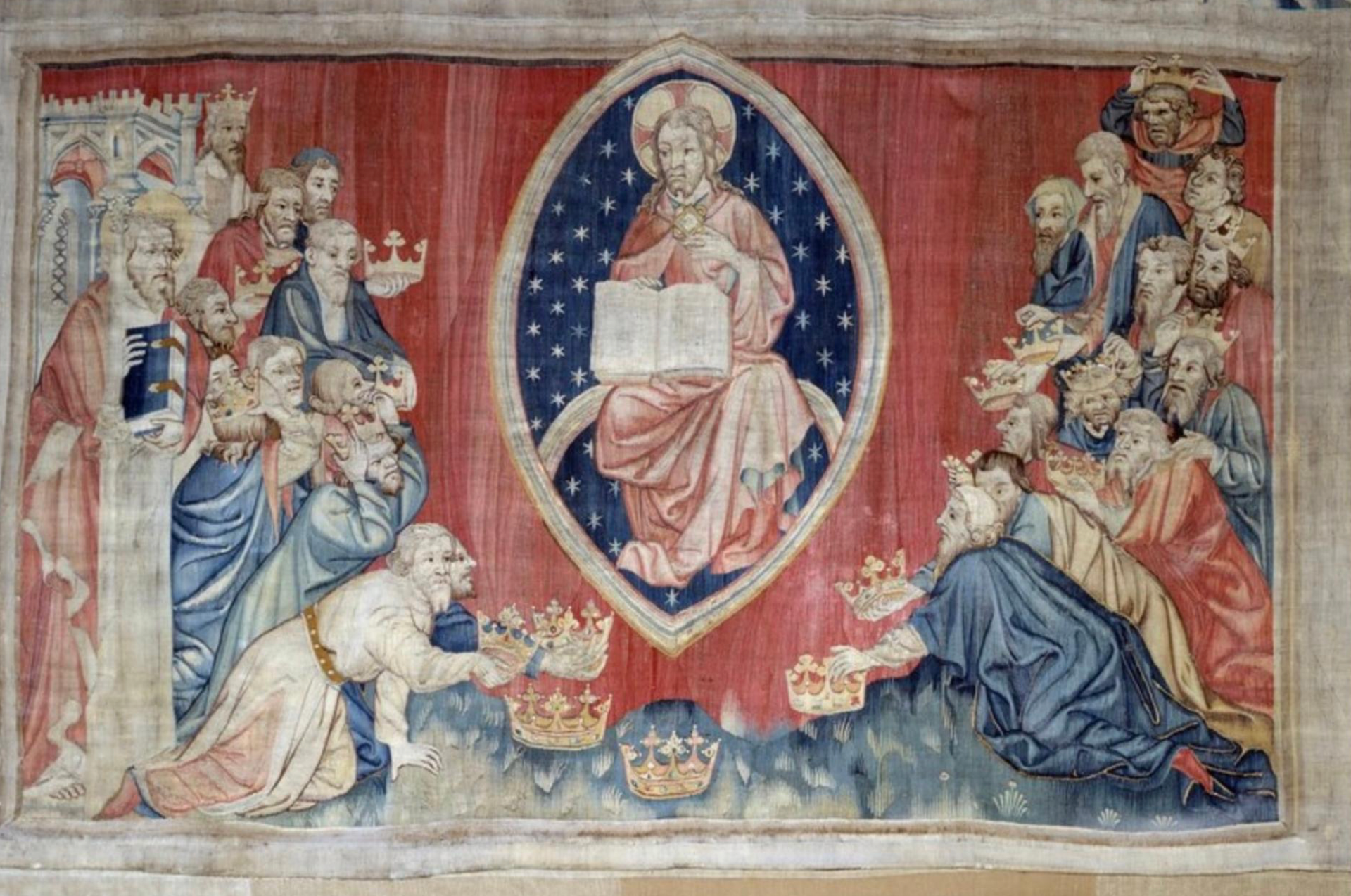
This passage has always felt like a personal story to me, not a corporate one. Maybe because I’m a woman who has had other people whispering behind my back about things they don’t understand, I’ve always felt a kinship with her. I own a print of the art on the cover of your bulletin, and it hangs in our bedroom.
Maybe because she seems so isolated and alone, the story has always felt like a personal story about where Jesus encounters each of us, individually, by our various wells, and not a story about how we live together as a society.
But this week, I was pretty wiped out. The news of the world is taking a toll. I know that our despair is the goal of this administration. And they might break the law with seeming impunity, but damn if I let them take my hope.
And so the work of tending my little flame of hope against the winds of cruelty has me pretty tired. Last week’s worship service was really powerful for me. The first hymn had me in tears, and I realized how alone I had been feeling in the midst of all the cruelty and chaos in the world. I was so thankful to be in community that day, your voices lifting me up as I cried through the hymn, visible reminders that I wasn’t alone.
And so, this week, as I pondered our friend at the well, I saw myself at the town well, there to gather water in the heat of the day, doing it “all by me own self”, as I would say to my parents when I was a kid. And I realized this is a story for how we live together. Why would we gather water by ourselves at shallow wells, when we could instead be supporting each other and helping each other carry the burdens?
And we can’t do it alone. Going to the well in the heat of the day instead of in the cool of the morning with others is no way to get through life.
A few weeks ago, when clergy were gathering in Minnesota, Joann and I were planning on going. And for various reasons, it didn’t work for us to be on that trip. But the stories I’ve heard from my friends who were there highlighted something for me. Yes, what is still happening in Minneapolis is terrible. What our government is doing is terrible on every observable metric. It shouldn’t be a partisan conversation to care about the Constitution, to
care about the humanity of our neighbors. We need to continue to bear witness to what is happening there, and what is happening away from public eyes in the detention centers where people are being kidnapped without cause, without warrant, without due process.
In addition to the bad news out of Minnesota, and Maine, and other places where ICE is wreaking havoc, our colleagues have shared amazingly positive stories too. The community has come together to help their neighbors, putting themselves at risk to do the right thing for strangers.
This is who we can be, who we can choose to be.
But Jesus has some questions for us.
He asks the woman about her husband. And after this week, I hear his question differently. I don’t hear it as shaming judgment. I hear it as reckoning and an invitation into deeper community and honest relationship. Because there she was, alone. Not in the community of other women. Was her isolation because of the stories they told about her or because of the stories she told in her own head? I know there have been moments in my life where I expected judgment and so I lived it out before anyone else even got involved.
Jesus cut right to the heart of the story she was telling herself and addressed the elephant in the room, or at the well. This is your story, he’s reminding her. You’ve had 5 husbands, with all the joys and sorrows that go along with them. This is your story. Claim it. Take it with you to the well with the woman and hold your head up high. It has made you who you are. Don’t forget it.
Jesus lets her know he already knew her story before he asked her for a drink, AND he chose to be there, talking to her, offering her living water, offering her grace that accepts her, loves her, values her, just as she is. He saw her, as she was. And it was enough. And true community requires honest truth.
We preach, or hear this preached, this every week, right?
God’s grace is sufficient for us.
We are God’s beloved children.
And then we somehow are still surprised to discover God knows everything we’ve ever done and is still there talking to us.
I think Jesus has some questions for us today too. Maybe not about our marital status.
How many people has ICE killed this month? I think that’s one question he would ask us. What are their names?
Thirty two people died in ICE custody in 2025. At least eight have died already this year at their hands.
Yet, I can only tell you the names of the two white people ICE killed.
There are reasons for that. We saw it on camera, for one. And the deaths in detention are intentionally hidden from us. But also, we live in a culture that has been killing black and brown bodies from the beginning of our story. Slavery, Jim Crow, the lynching trees, the redlining of real estate, the prison system, the list could go on and on.
When black and brown bodies are killed by the state, it does not shock us, even if it saddens us. We have seen it before.
We know the names of the two white people killed by our government this month because it is rare for us to see. But by standing in solidarity with their neighbors of color, they gave up the safety that comes with whiteness in this country.
Jesus wants us to see the honest truth about our lives, about our world.
Not to stop us in shame and judgment, but to call us to a well of living water, where Jesus meets us as we are and calls us to become who we can become.
Our government being racist now is not unprecedented, even as it is terrible. We have to see our past honestly so we can address the crisis of the present in a way that will change us.
John‘s gospel is all about what we see. And what we don’t see. We’ll talk more about this in a few weeks in a story about a blind man receiving sight. Jesus called the disciples at the beginning of the gospel by saying, “Come and see.” To come and see is the invitation to discipleship. To come and see is also our invitation into authentic community, where we honestly assess who we are.
At the end of the woman’s encounter with Jesus, she puts down her water jar and heads back to the city and tells everyone to come and see the man who told her everything she’d ever done. And we, as a society, need to reckon with everything we have ever done. We need to claim it and own it and then choose to create a different future for our children and grandchildren than the one we have lived, the one we have inherited.
And there are good parts to the story we have inherited too. We can’t lose sight of that. We have to claim it all.
She invites people to come see for themselves the man who told her everything she’s ever done.
If I’m a townsperson hearing that, my first thought is, “What is everything you’ve ever done. Do tell.”
If she wants to talk to people about Jesus, she’s going to have to tell her story honestly. If she says, “Trust me, it’s private, we had a moment, but it’s a good story”, everyone will walk away and leave her to her private experience.
How will they see the Good News of the Gospel and connect it to the parched and dry places of their souls if they don’t know how it has sated her soul?
She also makes her statement about Jesus being the messiah in the form of a question, which is a form of vulnerability, making a claim and acknowledging she might be wrong. We could use a world where more people acknowledged they might be wrong.
Jesus calls us to get past partial truths and to claim honestly all of who we are. God became flesh and lived among us, full of grace and truth. Do we think he doesn’t see us as we are? People, please. He sees you. And he wants you to see him as clearly.
There are plenty of other wells out there. Ultimately, those other wells won’t satisfy. The well of self-reliance, or the well of “everything is just fine, no need to bring up the past”, or the well of prosperity and success, or the well of fear and anxiety—they leave us temporarily sated but perpetually parched.
When we encounter Jesus at a well of Living Water, we bring our whole, vulnerable messy stories. If we want to go tell people about Jesus, we have to lay down the water jars we fill up at the well of safe truth.
What kind of wells do people find when they bring their empty water jars to our church?
Friends, we live in a world full of shallow wells, creating a thirsty, isolated world. There’s a lot of anxiety in the world, in the church, these days. There are a lot of people hungry for community where they can bring their whole selves. We’re here to see Jesus. We’re here to see each other as we are.
What if we allowed our brokenness to be recognized, to be seen, by the brokenness in each other?
I suspect we would find the living water Jesus offers, within our own communities, slaking our thirst and renewing our souls.
I suspect God would grace us with living water that would sustain us as we leave.
I suspect we, too, might go and tell our communities about this man who knew everything we have ever done... so they might come to meet Jesus, with their honest selves, as well.
We don’t need those water jars. Let’s leave them here.
Amen.