
Sermon 02.22.2026: Living, Dying, Rising
In John's Gospel, the signs Jesus performs are supposed to point people to see who Jesus is, to connect them to God. But in the sign of the blind man receiving his sight, it doesn't seem to work. When Jesus' signs don't match what we know to be true in the world, do we dismiss them, explain them away?
Scripture
John 11:1-44
Now a certain man was ill, Lazarus of Bethany, the village of Mary and her sister Martha. Mary was the one who anointed the Lord with perfume and wiped his feet with her hair; her brother Lazarus was ill. So the sisters sent a message to Jesus, ‘Lord, he whom you love is ill.’ But when Jesus heard it, he said, ‘This illness does not lead to death; rather it is for God’s glory, so that the Son of God may be glorified through it.’ Accordingly, though Jesus loved Martha and her sister and Lazarus, after having heard that Lazarus was ill, he stayed two days longer in the place where he was.
Then after this he said to the disciples, ‘Let us go to Judea again.’ The disciples said to him, ‘Rabbi, the Jews were just now trying to stone you, and are you going there again?’ Jesus answered, ‘Are there not twelve hours of daylight? Those who walk during the day do not stumble, because they see the light of this world. But those who walk at night stumble, because the light is not in them.’ After saying this, he told them, ‘Our friend Lazarus has fallen asleep, but I am going there to awaken him.’ The disciples said to him, ‘Lord, if he has fallen asleep, he will be all right.’ Jesus, however, had been speaking about his death, but they thought that he was referring merely to sleep. Then Jesus told them plainly, ‘Lazarus is dead. For your sake I am glad I was not there, so that you may believe. But let us go to him.’ Thomas, who was called the Twin, said to his fellow-disciples, ‘Let us also go, that we may die with him.’
When Jesus arrived, he found that Lazarus had already been in the tomb for four days. Now Bethany was near Jerusalem, some two miles away, and many of the Jews had come to Martha and Mary to console them about their brother. When Martha heard that Jesus was coming, she went and met him, while Mary stayed at home. Martha said to Jesus, ‘Lord, if you had been here, my brother would not have died. But even now I know that God will give you whatever you ask of him.’ Jesus said to her, ‘Your brother will rise again.’ Martha said to him, ‘I know that he will rise again in the resurrection on the last day.’ Jesus said to her, ‘I am the resurrection and the life. Those who believe in me, even though they die, will live, and everyone who lives and believes in me will never die. Do you believe this?’ She said to him, ‘Yes, Lord, I believe that you are the Messiah, the Son of God, the one coming into the world.’
When she had said this, she went back and called her sister Mary, and told her privately, ‘The Teacher is here and is calling for you.’ And when she heard it, she got up quickly and went to him. Now Jesus had not yet come to the village, but was still at the place where Martha had met him. The Jews who were with her in the house, consoling her, saw Mary get up quickly and go out. They followed her because they thought that she was going to the tomb to weep there. When Mary came where Jesus was and saw him, she knelt at his feet and said to him, ‘Lord, if you had been here, my brother would not have died.’ When Jesus saw her weeping, and the Jews who came with her also weeping, he was greatly disturbed in spirit and deeply moved. He said, ‘Where have you laid him?’ They said to him, ‘Lord, come and see.’ Jesus began to weep. So the Jews said, ‘See how he loved him!’ But some of them said, ‘Could not he who opened the eyes of the blind man have kept this man from dying?’
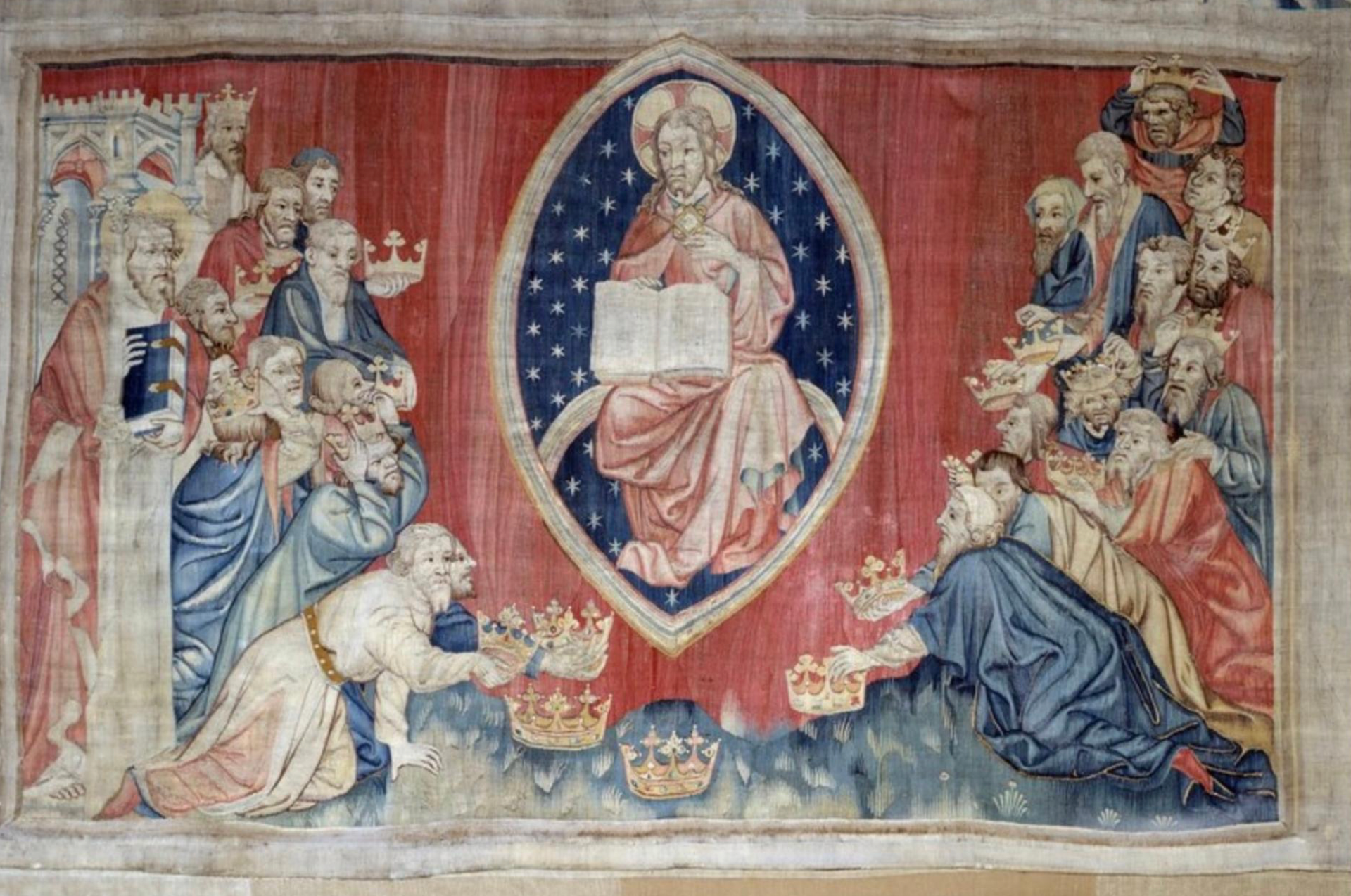
Then Jesus, again greatly disturbed, came to the tomb. It was a cave, and a stone was lying against it. Jesus said, ‘Take away the stone.’ Martha, the sister of the dead man, said to him, ‘Lord, already there is a stench because he has been dead for four days.’ Jesus said to her, ‘Did I not tell you that if you believed, you would see the glory of God?’ So they took away the stone. And Jesus looked upwards and said, ‘Father, I thank you for having heard me. I knew that you always hear me, but I have said this for the sake of the crowd standing here, so that they may believe that you sent me.’ When he had said this, he cried with a loud voice, ‘Lazarus, come out!’ The dead man came out, his hands and feet bound with strips of cloth, and his face wrapped in a cloth. Jesus said to them, ‘Unbind him, and let him go.’
Sermon
Jesus' friend, whom he loved, Lazarus, was dead. He was buried. He was in the tomb 4 days, and every good Jew knew that the soul never stayed with the body after 3 days. So, he was dead, dead, dead.
And Jesus arrives on the scene.
Martha rushes to him and said to Jesus, “Lord, if you had been here, my brother would not have died. But even now I know that God will give you whatever you ask of him.”
She acknowledges that she can’t see any life in this situation, but she also seems to acknowledge a willingness to rely on God’s imagination instead of her own. Even now, I know that God will give you whatever you ask of him.” Their conversation continues, and it is clear that Martha can imagine some of the good news—resurrection of the dead and eternal life. That good news is not for NOW. That good news is for the future.
“I know he will rise again on the last day,” she tells Jesus.
Mary also comes to Jesus, and she makes the same statement of faith. She too, believes in Jesus’ eventual power of death, of good news for some point in the future. Jesus has different words for her.
And it is clear, when they get to the tomb and Jesus tells them to roll away the stone, Mary and Martha aren’t ready for resurrection and new life quite yet. Eminently practical Martha, with no need of imagination says, "Lord, minor detail here, if I may. But already there is a stench because he has been dead four days.”
“Yes, Martha. Did I not tell you that if you believed, you would see the glory of God?”
And so, they roll away the stone, choosing to disregard everything they knew to be true about the way the world works, choosing to trust that God could see life where they only could see death. It must have seemed more like a zombie apocalypse than a moment of good news, though, waiting to see what Jesus was going to do with an open tomb.
“Lazarus! Come out!”
And Lazarus hears the voice of the shepherd and gets up from his tomb and walks out into the light, still wrapped in his grave clothes. While this is a story about Mary and Martha and Lazarus, it has some other important actors in it too. Mary and Martha are not alone in their grief. The community has gathered with them. And when Mary goes to see Jesus, the women go with her. Everyone’s grief is different, and personal. But it isn’t really private. These women don’t say anything, and they don’t offer platitudes. They stand with their friend who is in pain, so she’s not alone. And they cry with her as she and Jesus cry.
And there are people at the tomb.
Jesus commands the crowd to “Unbind him”!
Jesus is the one who calls Lazarus to life. But the crowd has work to do.
“Unbind him.”
I don’t know how comfortable you would be with this task, but no law-abiding Jew would touch a dead body casually. And I suspect they were all trying to figure out how the law applied to formerly dead bodies.
But again, like Mary and Martha, they trust in the voice of their shepherd.
And they unbind Lazarus, freeing him of the trappings of death.
This story has reminded me why we gather as the church.
We could be doing lots of other things today. Why do we take time out of our routines to gather together with other people to worship, to gather as church? I could talk for hours about the reasons we worship. But I want us to think about why we gather together in community.
Because community is messy and complicated. And as often as we love each other, or almost as often as we love each other, we hurt each other. We support each other in life, in death, and also when new life happens.
I was with some new members last night and they were talking about this aspect of community. Today it feels like we’re all so separated in our lives that it can be difficult to reach into someone else’s life to offer help, it can be a struggle to know our neighbors. I just moved to a new condo, and I try to say hello to everyone in the hallway, but only a few people have said more than “hello” back. A few have stopped and introduced themselves and asked, “Did you just move into the building? Welcome!” I want to know my neighbors. I also don’t want to freak them out by knocking on their door to introduce myself.
But we need people to stand with us, yes in our grief as Mary and Martha’s friends did, but also when we need to borrow a cup of sugar or need a meal after we’ve had surgery. We need community that is willing to ask, “Do you need help?” when we see a person struggling with too many bags.
One of the reminders of the Lazarus story is that while yes, there is eternal life and resurrection at some point in the future, we are reminded to proclaim that there is also NEW LIFE right NOW.
Our faith compels us to unbind people and call them into life today.
To let go of their belief that death, war, cruelty, and corruption have the last word. We need to unbind people so they can work to rid their lives of addictions and despair. We need to unbind people who have been hurt by religion so they can truly know and believe that they are beloved children of God, deserving of new life today.
New life isn’t always easy.
The community is called to the somewhat indelicate task of unshrouding the formerly dead Lazarus, so that he can return to life. How well do we do with that task? It is great to talk about new life, but how do we do when formerly dead Lazarii, Lazaruses (is that the plural?) show up in our midst? How well do we obey the command to unbind them, ushering them back into life? Or do we, instead, push them back inside the tombs?
I know we’d never admit to doing that. But consider addiction. When someone climbs out of the tomb of addiction, it is often the people who love them the most who have trouble with their new life. We have learned how to deal with the death of addiction. Sometimes it is life on the other side of it that makes us the most uncomfortable.
Or maybe there are people we’d really like to see buried in tombs, if that is what it would take for them to stop harming people. Are we open to God calling them to new life?
And this new life isn’t even easy for the formerly dead Lazarus.
How do you walk back into life once you’ve comfortably settled in a tomb? What must it have been like for him, who once was certain that there was no future for him, to discover that there was, indeed, a future with hope? Would people invite formerly dead people over for dinner? How would he fit in with the community?
And his very life was testimony to the power of Jesus Christ, he was another sign pointing to Jesus, which also made Lazarus unpopular with the religious leaders. When your life is testimony to the Good News you’ve received, things can be risky.
We are now in the season of Lent, which is a time of preparation for Easter. You’d think that maybe after experiencing the resurrection of Easter for over 2,000 years now, Christians would be better prepared for it. Somehow it still seems a shock.
The rhythm of living, dying, and rising is the story of our faith, and the rhythm of our lives. We worship a man who rose from the dead. After he had lived. And after he died.
If we pretend death isn’t necessary, and try to skip from living to rising, we deny the cycle of life and death, and we hang on to what God calls us to let go of.
If we pretend the messiness of life in community isn’t necessary, the living, living, living together through pain and joy, we deny the promise of faith.
If we pretend resurrection isn’t possible, we deny the promise of faith and will be unable to see miracles in our midst.
As I mentioned during the introduction at the start of worship, our work as a congregation, and our work as Christians in the world is to be asking the questions: What is living? What is dying? What is rising?
It may be easier for us to see what is living. We can feel where the energy is here at church.
But what do we need to let die? What do we need to go ahead and put in a tomb, with faith that God will make new life emerge in ways we cannot imagine? Because for us to be able to do well what God is calling us to do, we can’t also just keep doing all the things we have always done.
This is the messy and difficult part of being church. And your church leaders are in the middle of asking these questions of our programs and ministries. And it is hard. Because we love all the things we do. But the truth is, your staff is tired. Exhausted, really. One of the ways we managed the pastoral transition before I arrived and the postcovid return was to keep trying new things to see what works. But the problem with that is we are doing too many things, and not all of them are tied to our vision. We cannot continue to manage all the programs we are currently managing. Some ministries either need to end or need to really change and be led by members of the congregation, and not by the staff. And it will be hard because we like all the programs we have.
When we invite you to join a ministry team, it is not a vague invitation. It is a specific way for you to participate in the living, dying, and rising of Calvary. What are the specific things you can do? Maybe it is to greet and welcome people when they come to worship or events. Maybe you’re a cookie baker and want to bring treats to coffee hour. Maybe you can coordinate serving teams that feed people at one of our Matthew 25 partners. Maybe you want to support children or youth ministry. One of our recent new members has volunteered to be a wedding coordinator. And now that she’s helping me with that, I realize how much of that work I was having to do. And it is a huge relief for me.
What do we need to unbind? What are the things we thought for sure we had lost forever, that God is offering back to us in new ways?
It is our work as a church to look for living, dying, and rising.
I think it is also our work in the world. Think about the stories you heard in the news this past week, of corruption, abuse, and cruelty that need to be put in a tomb because the stench of their rot is hurting all of us. Think about the people and power systems that prop up these corpses of cruelty, telling us it is what life should be.
That isn’t living, my friends. The stench of death is all around it.
And think about Lazarus again. When he died, it was correct for his loved ones to put him in a tomb. Mary and Martha were correct to bury him. Even with a belief in resurrection, they could not resurrect their brother. Only God can do that. What is living, we need to support. What is dying, we need to let die. No matter how much we love. Acknowledging death is not a failure of love, it is the courageous embodiment of it.
What in our society do we need to help live and what do we need to let die? We don’t get to choose what resurrection and rising looks like and we do not know God’s timetable for it. We only know resurrection only happens after death.
We cannot resurrect the dead, but we are the ones, once God has called people by name, who have to be ready to unbind people from the wounds of their pasts. We are the ones who have to be ready to unbind people from the sins of their past behavior. Because new life has to be for us all. Can we be a community that walks with people out of their tombs and into the new life God is, even now, preparing?
Lent prepares us, again and again, to be Easter people, those who are looking for resurrection and trust God may be imagining new life where we see only death. And when we see people who are called to new life, as Lazarus was, we are called to unbind them, bringing them into new life that they can’t even imagine, and maybe we can’t imagine, as they take those first steps out of the tomb. Martha says to Jesus: 'But even now I know that God will give you whatever you ask of him. ’May that be our prayer too. May we have hearts strong enough to break open with grief when death occurs, and imaginations strong enough to be on the lookout for the new life God is creating.