
Sermon 03.01.2026: Bread, Bath & Beyond
On the night we expect bread and cup, John’s gospel gives us a towel and a basin. Jesus kneels, turning ritual into relationship and power into vulnerable love. Communion is not words at a table, but embodied connection that changes and binds us together—when we dare to be present.
Scripture
John 13:1-17
Now before the festival of the Passover, Jesus knew that his hour had come to depart from this world and go to the Father. Having loved his own who were in the world, he loved them to the end. The devil had already put it into the heart of Judas son of Simon Iscariot to betray him. And during supper Jesus, knowing that the Father had given all things into his hands, and that he had come from God and was going to God, got up from the table, took off his outer robe, and tied a towel around himself. Then he poured water into a basin and began to wash the disciples’ feet and to wipe them with the towel that was tied around him. He came to Simon Peter, who said to him, ‘Lord, are you going to wash my feet?’ Jesus answered, ‘You do not know now what I am doing, but later you will understand.’ Peter said to him, ‘You will never wash my feet.’ Jesus answered, ‘Unless I wash you, you have no share with me.’ Simon Peter said to him, ‘Lord, not my feet only but also my hands and my head!’ Jesus said to him, ‘One who has bathed does not need to wash, except for the feet, but is entirely clean. And you are clean, though not all of you.’ For he knew who was to betray him; for this reason he said, ‘Not all of you are clean.’
After he had washed their feet, had put on his robe, and had returned to the table, he said to them, ‘Do you know what I have done to you? You call me Teacher and Lord—and you are right, for that is what I am. So if I, your Lord and Teacher, have washed your feet, you also ought to wash one another’s feet. For I have set you an example, that you also should do as I have done to you. Very truly, I tell you, servants are not greater than their master, nor are messengers greater than the one who sent them. If you know these things, you are blessed if you do them.
Sermon
I. BREAD
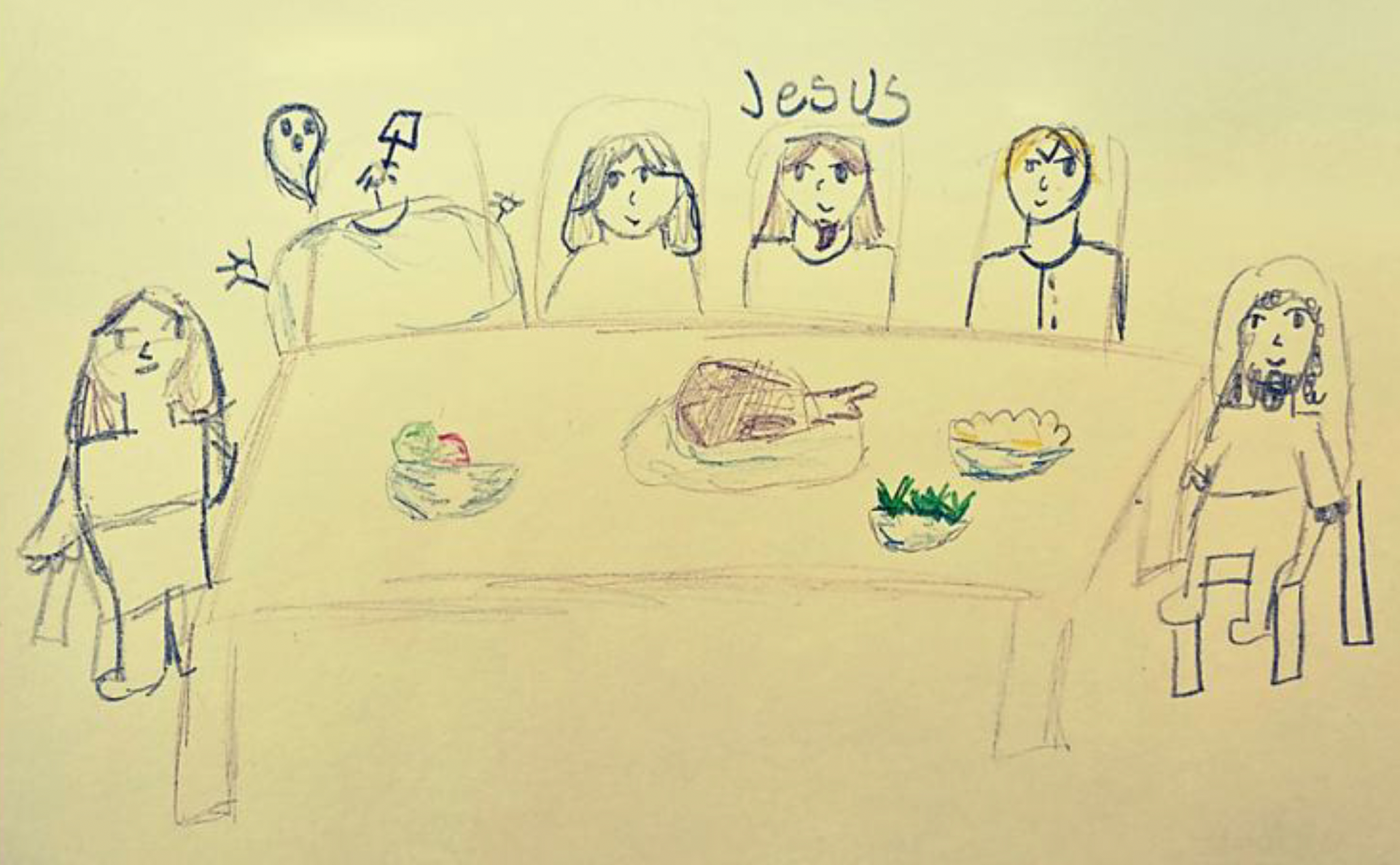
Body. On the eve of his death, when everything was about to fall apart, Jesus called his friends together, and did something totally unexpected. That’s so like him. I love about him. Now, John says that Jesus knew exactly what is coming. He knew his hour has arrived. He knew his betrayer was there in the Upper Room. Tradition teaches us to expect bread broken and cup shared. But instead, John gives us Rabbi Jesus, disrobing, stooping to the floor to serve his students. He doesn’t say, “This is my body. He doesn’t say, “Do this in remembrance of me.” Instead, he kneels by a basin, towel tied at the waist.
Communion is about more than the words of institution and symbols of bread and cup. Jesus show us today, communion is about how human bodies are instruments of blessing. Scholars have long noticed that John 13 replaces the institution of the Lord’s Supper with foot washing. Not because John rejects the sacrament—but because he wants us to teach us what communion means. Communion is never private. Likewise, foot washing cannot be rehearsed in theory. It requires close physical proximity. Consent. Vulnerability. Awkwardness. Jesus chooses this knowing his betrayers are in the room.
The followers of Jesus have never been completely unified. The church is a fragile flesh-and-blood system, the Body of Christ. From our inception we are a people stressed out and divided. Sound familiar?
In the first-century world, servants washed feet. Hosts provided water. Teachers did not kneel before students. Leaders did not get their hands dirty — which might also sound familiar. Peter knows this. His objection is not theological—it’s visceral. “Lord, are you gonna wash my feet?” And then the line that should stop us cold: “You will never wash my feet.” Peter is not just stubborn. It’s worse. He’s human. Like us. He can’t just receive something that might make him feel obligated, or awkward. He’s a self-sufficient man! Were he to accept, he might go soft, feel like burden.
II. BATH
Process Theology. Jesus doesn’t force Peter. He stays in the relationship. “You don’t know now what I’m up to,” he says,“ but later on you will understand.” God does not pressure. God lures us into the moment still unfolding. God does not coerce. God invites. God welcomes. The art of discipleship is all about improvisation. Holy jazz. Which is why Jesus tossed out the line: “Unless I wash you, you have no share with me.” You won’t be part of my ministry until you let me serve you—bathe away the residue of this world and its culture. Love, as George Herbert [7] just reminded us through the choir, does not overpower. Love pulls out a chair and says: sit, eat. St. Francis prayed [8] it is in giving that we receive. But John 13 says something deeper: sometimes it is in receiving that we give ourselves over to God.
Shared Identity. Shared acts of service—spiritual practices like praying together in silence, more practical ministries like cleaning your room, greeting someone as they enter the room, serving a meal at the Interfaith Winter Shelter— build a trust words alone cannot. They form us into something bigger than rugged individuality. The call on the African wisdom of Ubuntu: I am because we are. [9] The echo the old hymn: Blest be the tie that binds our hearts in Christian love. The fellowship of kindred minds is like to that above. [10] John must’ve understood shared identity long before neuroscience named it. He gives us service as sacrament, a way to bypass the head and be known in our bodies—even in our feet—opening our hearts from head to toe.
III. BEYOND
Christ’s Example. Then the part we usually rush past: “I have set you an example.” Not a commandment but a pattern. Do what I do. Do what I do when your world is unraveling and love is shapeless. Do what I do before beginning the next thing, before choosing, before quitting, before repeating the past You are blessed, Jesus says, not when you agree—but when you do what I do.
Reality Check Lest we think the Upper Room was long ago and far away, Jesus asks to kneel in the world we inhabit. The mess that is 2026, where yesterday, without Congress, without a declaration, without a single coherent sentence to justify it, we helped to bomb Iran on behalf of another nation. The supreme leader was assassinated, along with over fifty little schoolchildren, collateral damage—because when empire runs out of words, it reaches for weapons.
Good News. Here is the Good News. Jesus did not come to save a calm and orderly world. Even the Upper Room occurs in secret, with centurions roaming the streets, throwing citizens into their vans, and all while internal sabotage is underway. Jesus knows that he will be convicted of sedition.And that's when he kneels to serve. That's when he refuses to let relationships collapse.
John 13 is the perfect Lenten scripture. Why? It demands us that we change our posture. That’s repentance. It demands that consent to receive God’s blessing, even if we feel silly. ’Unless I bathe your feet, you have to part with me” silly.
Story: My First Communion. There was a time when I understood communion intellectually. And then there was the time when I learned it in my soul and my body. I had served a church for a couple of years as their director of music. It was not the right congregation for me. I was not the right servant for them. So much so, that when some young parents in the church heard I was gay, they acted surprised—aghast.
It’s not like I hide it, right? My honesty over my sexual orientation has kept me from ordination in the old Presbyterian Church and resulted in all kinds of complicated problems and insults and hurts. (Praise God for progress.) What were those parents thinking anyway? I was a 30-something-year-old single male church organist. And really cute—back then.
So they said that I must be dangerous and pressured the pastor to take the children’s choir away from me. And he did. I cannot tell you the pain I felt. Humiliation. Rage. Shame. I had no part in this decision, no opportunity to face my accusers. Back then, the church’s gay servants were on the menu.
Not because they thought we were bad people. But because that’s how institutions often organize. Against difference, against weaker members of the body. It works every time. Scripture says to hate what is evil. It doesn’t say to hate who is evil. That’s God’s job, the judging.
Then, God dared me to grow. Lured me to a church that was formed and led by queer people, not just any queer people, San Francisco queer people! And on a Sunday night, during an evangelical-flavored service on Eureka Street, I crawled up into the balcony, worshiped God with an undefended heart, and cried my eyes out.
They called us down for communion, and since I was a stranger, an unknown—I felt welcomed. I approached the server. She fed me the bread. Then, she put her hands on me. My little Presbyterian soul thought ‘what is this fresh hell'? Don't touch me! Sensing my unease, she whispered in my ear, 'I'm going to pray for you. Okay?' I nodded my consent, although I was just being polite. And she asked my name and blessed me. Victor, my brother. You are a blessing. God loves you unconditionally. Remember the part when the Grinch's heart grows three sizes? Yes, I received what the Spirit was saying through her. I would eventually pastor that congregation.
Celebration. John tells us: do not reenact a scene from long ago. Claim the communion power in this moment. It may happen quietly, awkwardly, tearfully. Receive it. Consent to it. The bread of heaven. The bath of transformation. And something beyond all that that only happens between bodies when our armor falls away. Wherever Love kneels and takes the towel, there is God. The question now is not whether we understand this—but whether we will stop pulling our feet away.
Affirmation of Faith. [11]
Nothing that is worth doing can be achieved in our lifetime; therefore we must be saved by hope. Nothing which is true or beautiful or good makes complete sense in any immediate context of history; therefore we must be saved by faith. Nothing we do, however virtuous, can be accomplished alone; therefore we are saved by love. No virtuous act is quite as virtuous from the standpoint of our friend or foe as it is from our standpoint. Therefore we must be saved by the final form of love, which is forgiveness.
Amen.
7 Love Bade Me Welcome < https://englishverse.com/poems/love>
8 < https://www.cathedralstm.org/about-our-catholic-faith/expressing-our-faith/treasury-catholic-prayers/prayer-st-francis-assisi-prayerpeace/>
9 < https://en.wikipedia.org/wiki/Ubuntu_philosophy>
10 < https://youtu.be/unoNFZm9jqs?si=ktwOOCu5a5pWLey3 >
11 from Reinhold Niebuhr’s The Irony of American History, University of Chicago Press, 1952